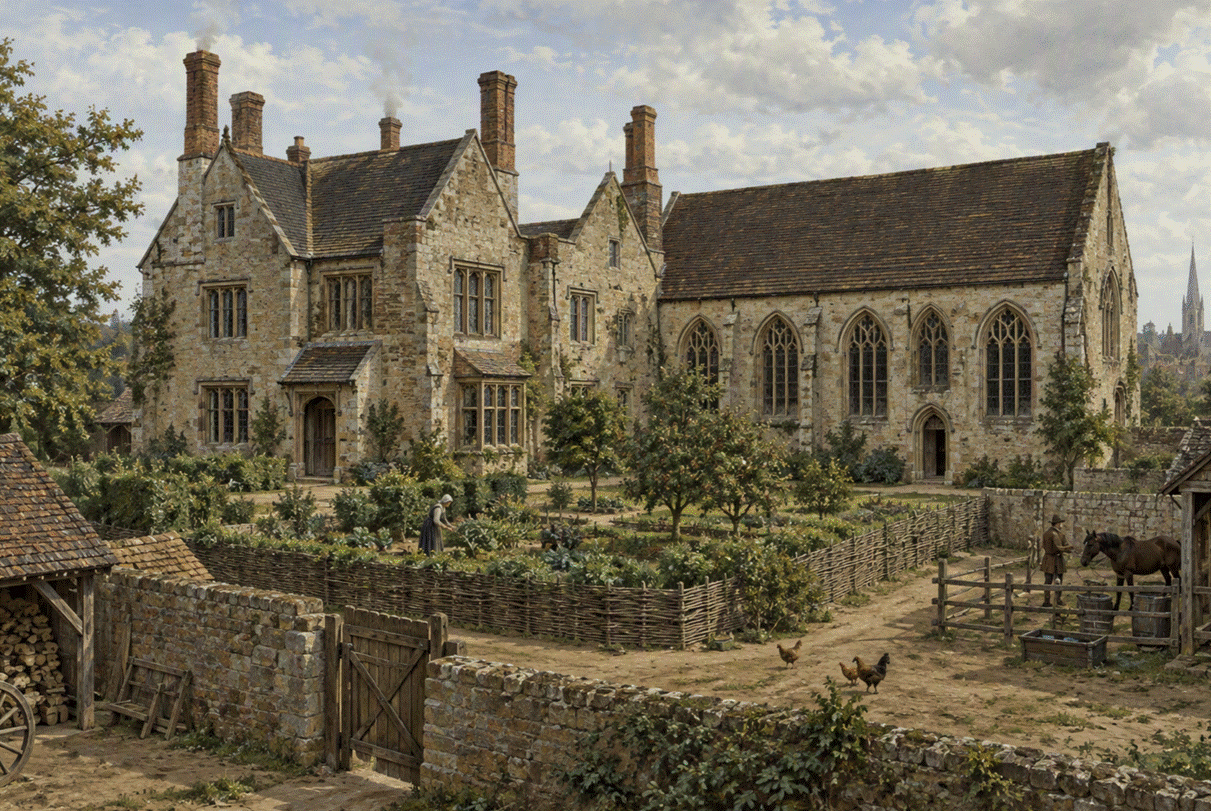
Charterhouse, Coventry in the Sixteenth Century
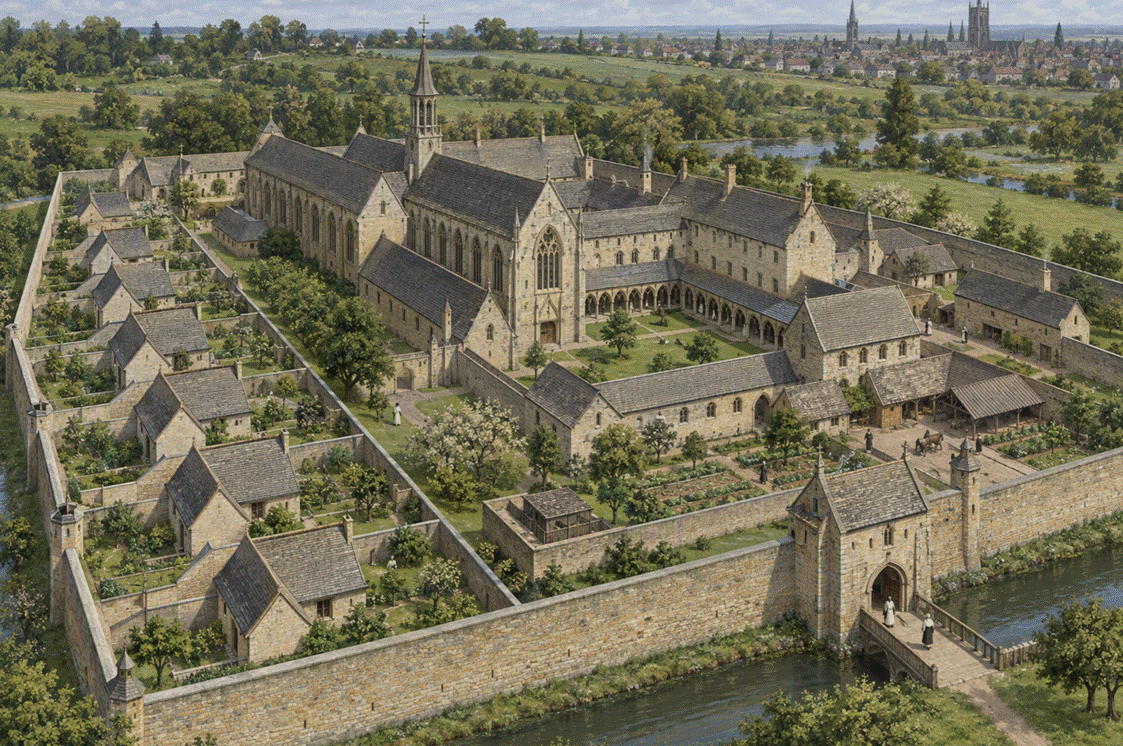
A
Carthusian monastery and after the dissolution of the monasteries, the home of
Robert Dudley, and then the property of Sampson Baker and later Humphrey Baker
|
Return to the Home Page of the Bakers Family part of the website |
The Bakers of Highfields Story
The Story of the Dods and Bakers and of Highfields,
Fenton House and Hasfield Court. A journey through the history of Cheshire
and Staffordshire, an Anglo-Saxon nobleman who retained his lands after the
Conquest, pottery at Stoke on Trent, an encounter with Elgar, and the history
of an Elizabethan manor house at Audlem |
The family tree of the Bakers of Highfields |
The Family Tree of the Dods, predecessors to the
Bakers of Highfields |
The Bakers of
Fenton House and Hasfield Court
The Family Tree of the pottery Bakers of Stoke on Trent |
The Family Tree of the Bellyse Family |
The main part
of this website tells the story of the Farndale family from Yorkshire Descendants of Arthur Baker, the story of the
Farndale ancestry is told through the main part of this website You can also return to the Farndale
website home page |
The genealogy of the family of James Hall, linked to
the Baker family through marriage to Arthur Baker |

Headlines of are
in brown.
Dates are in red.
Hyperlinks to
other pages are in dark
blue.
References and
citations are in turquoise.
Context and local
history are in purple.
The Carthusian
Order, known in England for their monasteries called Charterhouses,
represented
the most austere, solitary, and strictly contemplative form of monastic life in
medieval Britain.
Unlike communal orders, such as the Benedictines or Cistercians, Carthusians
lived as hermits in individual cells, breaking their silence only for specific liturgical
offices and rare communal meals. Out of only nine Carthusian monasteries
established in medieval England, the Charterhouse
in Coventry (the Priory of St Anne) and Mount
Grace Priory in North Yorkshire still provide a feel for the austere lifestyles.
Mount Grace is the most complete footprint of a charterhouse layout in Europe,
and hints at what Coventry’s Charterhouse once looked like.
Carthusian monasticism arrived in England in 1178 but
saw a significant surge in popularity during the late fourteenth century
following the Black Death. Wealthy patrons and royalty grew deeply anxious
about the afterlife, and the absolute, unyielding piety of the Carthusians made
them the most sought-after intercessors to pray for souls.
At Coventry's Charterhouse, archaeologists have excavated the
timber-framed foundations of its cells, suggesting that they mirrored the
layout seen at Mount Grace.
Carthusian Monastery
1381
The Carthusian Order was elite and exclusive; only nine
charterhouses were ever successfully established in medieval England. Founded
in 1381 with the foundation stone laid personally by Richard II in 1385,
Coventry's Charterhouse (St. Anne's) was a prestigious institution.
The monastery is founded by William la Zouche, Lord Zouche of
Harringworth. He obtained 14 acres of land at Shortley, south-east of the
Coventry city walls along the River Sherbourne, from Sir Baldwin Freville.
The project faced four years of political uncertainty and land
ownership disputes, which delayed major construction. Despite this, early
benefactors funded the initial planning of seven individual monks' cells.
1385
On 6 September 1385 Richard II and Queen Anne of Bohemia visited Coventry
and officially laid the foundation stone for the monastery’s church at the east
end of the choir. Richard II declared himself the principalis fundator (principal founder), sparking a wave of
high-profile financial backing from wealthy citizens and nobility.
Late
1380s
Prominent locals endowed further cells. Adam Botoner, a multi-term
Mayor of Coventry, bequeathed £20 for the eighth cell. Sir Nigel Loryng and the
Bishop of London procured the ninth, while other local figures funded the tenth
and eleventh cells.
1410
Construction was largely completed. The final layout consisted of
a church, a chapter house, a refectory, the Prior's house, and the Great
Cloister surrounded by 12 self-contained, two-storey monks' cells, each
equipped with its own private walled garden.
c 1417
A monumental, high-quality wall painting of the Crucifixion
featuring the Virgin Mary and St Anne was created within the monastery. This
became the only surviving medieval Carthusian wall painting in England.
15th
Century
The Charterhouse established an educational presence by housing 12
schoolboys on its premises, operating alongside the resident Prior, monks, and
manual lay brethren. Future monarchs, including Henry VI and Henry VII, stepped
in as royal benefactors to support the monastery.
1535
The Dissolution of the
Monasteries
Henry VIII
established the Act of Supremacy. Eighteen Carthusian monks across England were
executed for refusing to acknowledge the King as the Supreme Head of the Church.
While the Coventry monks escaped immediate execution, pressure mounted heavily
on the priory.
In Henry VIII’s records, there was a reference to eight letters
of uncertain years addressed to the Prior of Charterhouse, London,
including one by the Prior of Charterhouse beside Coventry dated 22 October
(Public Records of the reign of Henry VIII, Volume
8, Folio 611).
The context was a moment of political tension amongst the Carthusian Order,
just before the full-scale suppression of their houses. In 1535, the
Carthusians were at the epicentre of King Henry VIII’s religious reformation.
The year before, the Act of Supremacy 1534 had declared the King to be the
Supreme Head of the Church of England. The monks of the London Charterhouse
famously refused to swear the Oath of Supremacy. In response, Henry VIII
launched a campaign of brutal terror. In May and June of 1535, the Prior of
the London Charterhouse, John Houghton, along with other leading Carthusians,
was executed by being hanged, drawn, and quartered. The
letter dated 22 October 1535 from the Prior of the Charterhouse beside Coventry
to his counterpart in London was communication during this atmospheric
crackdown. Crown officials like Thomas Cromwell intercepted these networks of
letters to check for signs of organised, treasonous, Catholic resistance or to
pressure localised priors into submission before the royal commissioners
arrived.
The letter evidences that Coventry was
tightly integrated into the national network of spiritual and political power,
keeping direct lines open with London.
While the London Carthusians chose martyrdom, the Coventry house attempted
to navigate the political storm. Ultimately, compliance bought them only a
little time. A few years after this correspondence, on 16 January 1539, the
last Prior of Coventry (Prior Bochard) was forced to
formally surrender the monastery to the Crown. The church was demolished, and
55 tons of lead were stripped from the roof and melted down. The Prior’s House
and refectory survived because they were sold into private hands as a secular
mansion. It was later owned by Robert Dudley, Earl of Leicester, the favourite
of Queen Elizabeth I, and then by Sampson Baker (BAK00008).
1536
The Dissolution of the Lesser Monasteries Act was passed. Although
the Coventry Charterhouse survived the first wave of closures targeted at
smaller institutions, its operations entered their final, highly restricted
phase under the looming shadow of total suppression by the Crown.
Henry VIII’s Dissolution of the Monasteries hit Coventry
exceptionally hard. As a major ecclesiastical centre, the city was stripped of
its wealth, and its influential religious institutions, including Whitefriars,
Greyfriars, and the Benedictine Priory of St. Mary's, were dissolved and
looted.
Charterhouse, Coventry, along with three other northern Carthusian
houses (Richmond, Hull, and Mount Grace), turned to the Archbishop
for urgent guidance as the Crown began enforcing the royal supremacy over the Church.
The Carthusian monks were deeply traditional and historically resistant to
breaking away from Rome. Confused and terrified by the demands of Henry VIII’s
royal visitors, the Coventry monks travelled to Edward Lee, the Archbishop of
York looking for a theological or legal loophole to save their monastery or
their consciences. The Archbishop gave evidence to the
King that he did not encourage them to resist, but pressured the monks to
capitulate, take the necessary oaths, and to accept Henry VIII as the Supreme
Head of the Church, assuring them that many great learned
men had already done so. On 14 January 1536 Archbishop Lee wrote to Henry
VIII, When Drs. Layton and Leghe were with me as
your visitors on Jan 13, they very straitly examined me concerning words that I
was supposed to have spoken to the general confessor of Syon or to one sent by
him, viz, that I would stand against your title of Supreme Head even to the death,
if I thought that I might prevail. Never spake with
the said confessor, nor sent any counsel to him, nor received any messenger
from him or any one at Syon in matters concerning your Highness. Have had
nothing to do with any from Syon since coming to my diocese. Four
charterhouses, Richmond, Coventry, Hull, and Mount Grace, have come to me for
counsel. I have always said to them " What counsel shall I give you but to
do as I have done myself, and as many other have done, both great
learned men, and taken for good men, and that they might not think that
such men would do but that they might avow (Public
Records of the reign of Henry VIII, Volume
10, Folio 99).
Then came a report, as part of the Dissolution of the Monasteries
programme, on the value of the Carthusian priory nigh to Coventry, £161 6s 8d,
(2) £201 7s. 6d (3) Twelve with the Prior; all priests; in virtue and religion
excellent; desiring, if the house be dissolved, to be sent to other houses; (4)
Twenty-one, " whereof converses' professed 3 yeomen servants 6, children
brought up in virtue and learning found there of alms 12.", (5) £89 7s 6d;
the house in very good repair; (6) £31 18s 5d; (7) 7 ½ acres, of which 6 are woods of 7 years'
growth, &c; no parks, forests, or commons; (8) £90 5s 5d of which £60 are owing
to the King for part of the first-fruits. (Public
Records of the reign of Henry VIII, Volume
10, Folio 1191
(2)).
This report details the evaluation and impending dissolution of
the Carthusian Priory near Coventry.
Financial Breakdown. Annual
Income / Valuation was divided into two assessments: £161 6s 8d and £201 7s 6d.
Moveable Goods & Assets were valued at £89 7s 6d. Regarding Outstanding
Debts, the priory owed £90 5s 5d, which includes £60 owed directly to the King
for first-fruits (ecclesiastical taxes). The
priory was owed £31 18s 5d by others.
Community & Inhabitants.
Monks: 13 total (12 monks plus the Prior). All were ordained priests described
as excellent in virtue and religion. If the house was dissolved, they
requested transfer to other Carthusian houses. Lay Residents & Servants: 21
total, consisting of 3 Converses or Lay brothers who have taken vows; 6
Yeomen Servants, being domestic staff and 12 children, housed and educated in
virtue and learning, supported entirely by the priory's alms.
Property & Land. The
priory buildings were in very good repair. The landholding comprised minimal
land totalling 7½ acres, which included 6 acres of woods (7 years' growth). The
property contained no parks, forests, or common lands.
Charterhouse in Warwickshire (ie Coventry’s
Charterhouse) was listed in a list of monasteries in England of less yearly
value than £200 in 1238 (Public Records of the
reign of Henry VIII, Volume
10, Folio 1238).
In the immediate aftermath of the Lincolnshire Rising, a major
regional rebellion against the religious reforms of King Henry VIII, it was reported
that Thomas Kendall, Vicar of Louth was at Charterhouse, Coventry in 1536,
where he made labour to be admitted a brother (Public
Records of the reign of Henry VIII, Volume
11, Folio 970
(page 394)). On Sunday, 1 October 1536, Thomas Kendall delivered a fiery sermon
at St. James' Church in Louth. He warned his congregation that royal
commissioners were on their way to enforce the Act of Suppression, dissolve
local monasteries, and seize the parish’s prized silver, jewels, and treasures.
His words ignited the Lincolnshire Rising. The very next morning, locals, led
by a shoemaker named Nicholas Melton, known as Captain Cobbler, seized
the Bishop of Lincoln's registrar, burned his books, and mobilised tens of thousands
of armed protesters. However, the movement collapsed quickly when faced with
the king's forces under the Duke of Suffolk by mid-October. Knowing
he was a marked man for inciting treason, Kendall fled Lincolnshire to evade
capture. He arrived at the Carthusian monastery of Charterhouse, Coventry,
seeking sanctuary and attempting to be admitted as a monastic brother. The
Carthusian monks ultimately declined to admit him into their order as a full brother.
However, they did permit him to stay in Coventry under the guise of practicing medicine , physic, and he occasionally lodged with
them. Unbeknownst to the monks, Kendall used his time in Coventry to secretly
smuggle letters back to his sympathizers in Louth. Royal agents tracked these
letters, leading to a midnight raid on Christmas Eve 1536, where Kendall was
hunted down and arrested. He was taken to the Tower of London, convicted of
high treason, and executed via being hung, drawn, and quartered at Tyburn on
March 25, 1537. Ten of the Coventry Charterhouse monks were forced to write to
Thomas Cromwell declaring their absolute innocence, explaining they had no idea
who Kendall truly was when he knocked on their doors.
1537
On 4 January
1537, a letter from the Monks of the Charterhouse near Coventry to Thomas
Cromwell. They wrote Touching a priest named Sir Thomas Kendall, who came to
them saying that he came from Oxford, and was beneficed within three miles of Colchester,
and desired to be received into their religion. They communicated with the
prior, who was then at London, and declined to receive him, but he remained
using physic within the city and in the country, sometimes lodging in their
house, and sometimes in the city. He sent writings without our knowledge to
certain men of Lowth by a messenger of ours, which
were shown to the Duke's deputy at Lincoln, who sent
men to our house on Christmas Eve, and took the priest while we were at rest. Protest
their entire innocence. The Charterhouse next Coventry. (Public Records of the reign of Henry VIII, Volume 12 –
Part 1,
Folio 19).
On 12 January
1537, the questions for the interrogation of the Vicar of Louth were prepared. (1.)
Where and when had you the first communication of the insurrection in Lincolnshire,
and with whom, and how devised you to set the said insurrection forward, and by
whose aid, comfort, and counsel ? (2.) What was done
day by day ? (3.) For what cause and to what end made
you it ? Who were their sugges[ters] and surmisers to stir the people to follow you ? (4.) Who conveyed them from place to place so shortly,
and by what means ? (5.) What fashion used you to
cause this ? (6.) By whose study and diligence was
that done? (7.) Who were the greatest stirrers ? (8.)
How they met ? (9.) How were they harnessed,
victualled, and by whose help ? (10.) Who were their
aiders and counsellors by word or writing ? (11.)
Whose counsel used you most to keep you together, and " what intend you
then to cloy ?" (12.) " What caused them to goy home after the proclamation," and who opposed this ? (13.) How was it so many gentlemen and others were
taken, as they pretended, against their will, and no stroke stricken
? (14.) Why told you not your parishioners, when they assembled first,
that their rumours and tales was untrue, and their pretence and doings contrary
to the laws of God and nature, and this realm, and to their fidelity and oath
of obedience to their prince ? (15.) " What
caused you to smite your parishioners of Lowth of the
back, bidding them to go forward justly, for they should have goods and riches
plenty at London ? (16.) What moved you to goy the Chartershows, and for what intent?" . In answer to the last question, a
chorist of Louth gave evidence that Neither
the prior nor any of the convent of Coventry knew he was vicar of Lowthe, for he told them he came from Oxford and was
beneficed beside Colchester. (Public Records of
the reign of Henry VIII, Volume 12 – Part 1 Folio 69
(p. 33), 70
i).
Perhaps following their cooperation over the trial of Thomas
Kendall, there was a short lived exemption from
suppression of the Carthusian priory of St Anne near Coventre,
where John Boucheard was to be the prior (Public
Records of the reign of Henry VIII, Volume 12 – Part 2, Folio 411
(23)).
1538
In 1538, Humfrey Reynoldes of Coventry, a yeoman of the Crown, submitted a
reform proposal to reorganise the lands and revenues of abbeys, using the Black
Monks (Benedictines) of Coventry as a blueprint. He argued that despite holding
some of the most profitable lands in the realm, religious houses were heavily
in debt. The Coventry monks had a revenue of nearly £1,000 but were in debt for
almost the same amount, partly because the bishop held £300 of their best
lands. The monasteries force tenants to overbid for convent leases, causing
local disputes and variance. The ill living and conversation of the
monks, and their failure to live according to their vows, was cited as a
primary reason for the dissolution (pulling down) of abbeys. Monks spend over
£40 per individual, yet failed to maintain their full
numbers or upkeep their houses. Reynoldes proposed capping
the total expenditure at roughly £1,000 yearly by restructuring the monastery
into a combined religious and secular military/administrative estate. The
revenue would support 20 monk-priests. The Abbot or Prior's role would be
restricted to spiritual guidance over his brethren, stripping him of control
over temporal (financial/worldly) matters. The Prior would receive 40s
annually, the subprior 20s, and each monk 6s 8d, with each monk also supporting
a student scholar in the almonry until they become priests. The abbey's wealth
would instead fund a structured hierarchy of secular officials, gentlemen, and
soldiers who would receive fees, clothing liveries, housing, and meals.
Leadership would be provided by a Head Captain/Justice of the Peace (£40 fee)
and a Petty Captain (£20 fee); administration by an attorney/controller,
steward, receiver, marshal, and a physician; with a Garrison/Retinue of 15
gentlemen, 15 yeomen, 15 grooms, and 15 pages—all required to provide their own
horse, harness, and weapon, and share a bed between two.
City and Monastery of Coventry
Scheme for utilising the lands of abbeys by
[Humfrey Reynoldes] of Coventry, who has admitted yeoman of the Crown at [the
suit of Sir Fras.] Bryan, at the King's last being at Ampthill.
Religious houses have as goodly and profitable
lands as are within the realm, and yet few keep themselves out of debt or
maintain their houses, and by making men overbid one another for convent leases,
they set men at variance. Their ill living and conversation was
partly the cause of the pulling down of abbeys, and few or none live after
their profession. Houses of religion and especially Black monks may spend 40l.
and above for every mo[nk]
and yet have not their full number.
Proposes a scheme for reform at Coventry,
which might be applied to other places. The Black Monks there can spend little
less than 1,000l. in rents, and yet the bishop has 300l. of their best lands. Few
men are maintained and they owe near 1,000l. Proposes that the revenue should
be spent in supporting 20 monks, priests; the abbot to meddle only with his
brethren and not with temporalities. The abbot or prior to have 40s. in ready
money yearly, the subprior 20s., and every monk 6s. 8d. Every monk should have
his scholar found in the “ambre,” (almonry) till he
be priest. There should be a head captain, a justice of the peace with 40l. fee
from the abbey and 6l. 13s. 4d. for his livery; a petty captain with 20l. and
4l.; an attorney and controller, 20 mks. and 5 mks.; a steward 20 mks and 5 mks.; a receiver, 10l. and 35s.; a marshal, 5l. and 35s.; a
physician, 4l. and 35s.; 15 gentlemen, 4 mks. and 7
yds. cloth at 5s.; 15 yeomen, 40s. and 7 yds. cloth at 4s.; 15 grooms, 26s. 8d.
and 7 yds. cloth at 3s. 4d.; 15 pages, 20s. and 7 yds. cloth at 3s. 4d.; all
these to have meat, drink, horsemeat and man's meat in the abbey, and horse, harness
and weapon of his own, and every two a bed. Including necessary servants and
artificers, this would cost about 1,000l. yearly. The necessary hay, corn,
&c., might be provided by saving in the monk's commons, for which 4l.
yearly is allowed, but there is now no priest in these parts that is above 3l.
commons if there be a company together. Complains of the monks enhancing their
seals. They sometimes get 100l. for the seal of 10l. fee; and how should
younger brethren and yeomen live, having neither land nor fee, if gentlemen and
merchants give such large fines? The King's yeomen are sure to have little or
nothing, except by promotion of the King's own land, and even then, knights or
gentlemen will give a fine to take farms or bailiwicks out of their hands.
The house has divers
hospitals, chauntries, and other benefices, which are
used contrary to the founder's will. Proposes that the head captain should be justice
of the peace where his fee is.
There must be a remedy found for the decay of
cities and corporate towns. The decay of Coventry and all other parts of the
realm is for lack of learned men to be on their councils, and administer
justice, and there is no city or good town without an abbey near it, in which
the justices might sit. The mayor being appointed for one year, “driveth forth his time, what for affection and foolish
pity,” so that men go unpunished. Some men may think that this would be against
their liberties, but it is not so, for these men shall be citizens and
townsmen. They shall not come into the council house with the mayor and his
brethren unless summoned. They must have houses within the city, which will be
glad to have substantial learned men among them, “and the poor husbandmen will
be best content that they be so far from them, whereby they may occupy their
pastures and closings to their best use. For if they dwelled nigh them, if there
were other (either) profit or pleasure in them, they would have them from
them.” The justice shall go in general processions next the mayor with the
recorder, and the attorney and steward with the councillors of the city. Trade
is decayed. There is little “made ware” but what comes from beyond sea, so that
if the commons would work, they could not sell. Acts are made to punish
vagabonds, but it were expedient to find means to set them
to work. Acts have been made to reform part of these made wares, but no man
takes pain therein. Unlawful games are used, so that the artillery is decayed.
Has seen 10 or 12 companies going shooting, but now a man should seek through
the city or he could get one company to shoot “half
take pence.” The should be reformed, for unlawful
games make men sit at the alehouse, when they have a penny to spend, and they
care not what inventions they imagine. Refers to the insurrection in the city
after the death of Mr. Swillington, the recorder, who, while he lived, kept the
people well in awe. Of the four men who sued to the King for the commission by
which the offenders were punished, one only remains in the city. He is both
loved and dreaded for his humanity, and if ought come to him but good, they
would neither set by mayor nor recorder nor by one another. The charges of
holding office are so great that when a man has got his living, he sues to an
abbey for a convent seal or else goes to farm in the country. Some sue for
licences to exempt them from offices. The writer, “with other which come of the
younger brethren,” has no fee nor wages nor occupation; if his wife died he would lose part of his lands, and then he should be
taken into office of the city and in two or three years spend all that his
friends have gotten for him. And therefore he sued to
his master to put him to the King's service, that he might avoid the said
offices which every man seeks to avoid. Begs the King to maintain the cities so
that honest and wise men may be glad of the offices.
When the city and monastery are set in order,
the captain and council shall ride and view the tenants and farmers. Rents
should not be raised by them nor fines taken; but to find men with horse and
harness and wages for a month or two. Sales of wood must be at a reasonable
price, so that the buyer may have a living. If lords and great men would live on
their lands, and leave farms and merchandise, priests live on their benefices,
and merchants and craftsmen live by their occupations in cities and towns, and
let the poor husband[man] live by his husbandry, then the realm would prosper.
This the captain and council will help to do.
(Public Records of the reign of Henry
VIII, Volume 13 – Part 2,
Folio 1198
(page 505))
While this provides a historical snapshot of the early 1530s, the
Crown ultimately went in a completely different, much more radical direction.
Reynolds' reform plan was heavily motivated by personal frustration. He was an
ambitious local man who had been repeatedly outbid by wealthy merchants when
trying to lease lands from the wealthy Coventry Priory. His petition was
essentially an attempt to get Henry VIII to strip the monks of their financial
power so that local men like himself could benefit. The
monks of Coventry Priory actually held an emergency
chapter meeting around 1533 specifically to plan their defence and appeal
against Reynolds' hostile proposals.
Henry VIII and his chief minister, Thomas Cromwell, chose not to
reform or repurpose the monasteries into administrative military estates as
Reynolds envisioned. Instead, they opted for complete Dissolution.
In 1539, just a few years after this proposal, Coventry Priory was
fully suppressed and surrendered to the Crown. Rather than being turned into a
secular administrative house with captains and pages, the monastic buildings
were completely dismantled, the cathedral church was defaced and ruined, and
the vast lands were sold off or granted to wealthy royal favourites and the
city's civic elite.
On 11 February 1538, the abbeys of Kenellworthe
and Combe, prior of Coventry, charterhouse of Coventry, were on a list of
the larger monasteries (Public Records of the reign
of Henry VIII, Volume 13 – Part 1 Folio 254).
On 29 September 1538, in the augmentation accounts there were
fines recorded for toleration and continuance of monasteries, including £20 in
respect of St Anne’s beside Coventry (Public
Records of the reign of Henry VIII, Volume 13 – Parts 2 Folio 457
I (3)).
On 6 November 1538 Dr London reported that when he was at Charter
house of Coventry, Colme is within three miles. (Public
Records of the reign of Henry VIII, Volume 13 – Part 2 Folio 767).
Dr.
John London was a prominent English cleric, legal scholar, and civil servant.
He served as the Warden of New College, Oxford and became one of the most
notoriously energetic royal commissioners deployed by Thomas Cromwell during
the Dissolution of the Monasteries. Dr London was at the Charterhouse of
Coventry in his capacity as a royal commissioner. His mission was to suppress
the city's religious houses, seize their valuables for the Crown, and force the
monks to sign deeds of surrender. Coventry was heavily targeted during
this period; its Whitefriars monastery was suppressed around October 1538, and
Dr. London was systematically moving through the remaining houses, including
the Charterhouse and the massive St. Mary’s Benedictine Priory. Colme refered to Coombe Abbey, a wealthy Cistercian monastery
located just over three miles east of Coventry.
Dr. London noted that the monks at these institutions knew their
closure was imminent. They were actively trying to secure their personal
futures by quickly selling off timber woods, granting cheap long-term land
leases, and hiding or melting down their valuable silver plate. By highlighting
how close Colme was, London was urging Cromwell to let him seize it immediately
while at the best before the abbot and monks could dilute its financial
value. Coombe Abbey was ultimately surrendered to the Crown shortly afterwards.
On 28 December 1538, in a letter to Thomas Cromwell he Sends a
poor token with good wishes for the new year. Sends also Cromwell's half-year's
fee from him and his house. Will now execute Cromwell's commission in places
where he has not been yet. He Has also received the unwise letters
written by the monks of the Charter House in Coventry. Trusts to accomplish
Cromwell's pleasure there and at the priory. As Colme is so nigh to Coventry,
and the abbot and all his friends at Cromwell's command, would be glad to go
through with that house also. All the sort of them look
daily for their departing and make their hands by leases, sales of wood, and of
their plate. Supposes this abbot will leave his house and lands like an honest
man, and Cromwell had better take the house while at the best. (Public Records of the reign of Henry VIII, Volume 13 –
Part 2 Folio 1153).
1539
The monastery was ultimately be forced to surrender to the King
three years later, in January 1539. Prior Bochard
was forced to surrender the monastery to the Crown. The monks were evicted, the
church demolished, and the site systematically looted. Around 55 tons of lead
were stripped from the roofs and melted down. Only the stone Prior’s House and
the refectory range were spared to be sold as real estate.
1542
The Crown sold the remaining property to Henry Over, a wealthy
Coventry mercer, officially launching the site's era of private secular
ownership.
The Robert Dudley Era
Early
1560s
Robert Dudley, 1st Earl of Leicester, and favourite of Queen
Elizabeth I, acquired the estate. Dudley held the property for about four years
during the Elizabethan period.
Dudley initiated extensive remodelling of the austere monastic
block into a luxurious, secular manor house suitable for high-society
entertaining. He was credited with commissioning grand Renaissance-style wall
paintings within the building.
Sampson Baker's Ownership
Mid-1570s
The property passed into the hands of Sampson Baker (BAK00008), a
prominent local gentleman formally styled in contemporary records as being of
le Charterhouse by Coventry.
1575
Sampson Baker expanded on Dudley's artistic works by commissioning
a series of prominent, high-quality black and white wall paintings that
prominently featured the Baker family coat of arms.
1577–1578
Sampson Baker was formally recorded as a prominent resident of
Warwickshire living at the Charterhouse.
Humphrey Baker and
Financial Strife
1584
Sampson Baker died. The Charterhouse was inherited by his nephew
and legal executor, Humphrey Baker (BAK00010A).
1585
Humphrey Baker inherited a series of compounding legal troubles.
He was sued in Chancery court by an attorney named Roland Durant, who attempted
to recover outstanding debts linked to Sampson Baker’s estate.
Bibliography
Berger, R (1993), The Most Necessary Luxuries: The Mercer’s
Company of Coventry, 1550–1680, University Park: Penn State University
Press, pages 59–81.
Hulton, M (1979), Coventry and its People in the 1520s,
Stratford upon Avon: The Dugdale Society.
McGrory, David (2004), A History of Coventry, The History
Press.
Phythian-Adams, C (1979), Desolation of a City: Coventry and
the Urban Crisis of the Late Middle Ages, Cambridge: Cambridge University
Press.
Woodhouse, Frederic W (1909), The Churches of
Coventry.
The City of
Coventry: Crafts and industries, Modern industry and trade in A
History of the County of Warwick: Volume 8, the City of Coventry and Borough of
Warwick. Originally published by Victoria County History, London, 1969.