Malpas
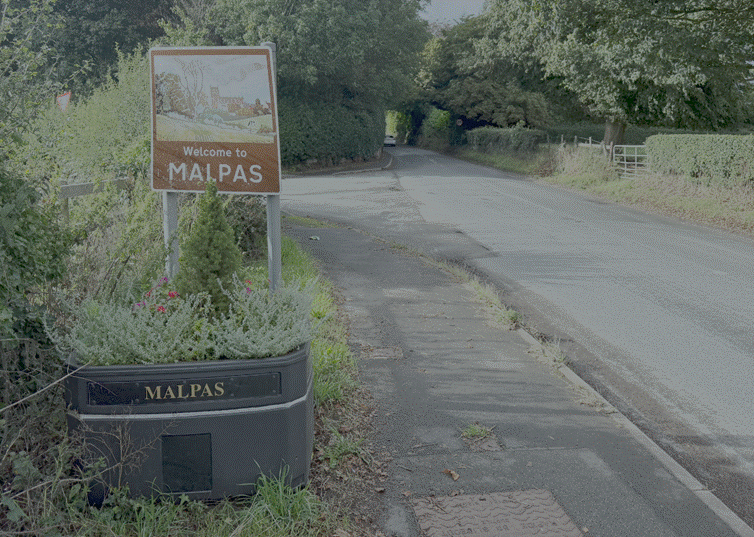
A history of medieval Malpas and
its deeper roots
|
Return to the Home Page of the Bakers Family part of the website |
The Bakers of Highfields Story
The Story of the Dods and Bakers and of Highfields,
Fenton House and Hasfield Court. A journey through the history of Cheshire and
Staffordshire, an Anglo-Saxon nobleman who retained his lands after the
Conquest, pottery at Stoke on Trent, an encounter with Elgar, and the history
of an Elizabethan manor house at Audlem |
The family tree of the Bakers of Highfields |
The Family Tree of the Dods, predecessors to the
Bakers of Highfields |
The Bakers of
Fenton House and Hasfield Court
The Family Tree of the pottery Bakers of Stoke on Trent |
The Family Tree of the Bellyse Family |
The main part
of this website tells the story of the Farndale family from Yorkshire Descendants of Arthur Baker, the story of the
Farndale ancestry is told through the main part of this website You can also return to the Farndale
website home page |
The genealogy of the family of James Hall, linked to
the Baker family through marriage to Arthur Baker |
Headlines of are
in brown.
Dates are in red.
Hyperlinks to
other pages are in dark
blue.
References and
citations are in turquoise.
Context and local
history are in purple.
Roman
40 to
50 CE
Discovered by a metal detectorist on 9 January 2014, the Malpas
Hoard is a collection of 35 ancient coins buried around 40 to 50 CE. The
find includes 28 Roman denarii struck during the Roman Republic and
early Empire, alongside 7 Iron Age British coins minted by the Western (Dobunni)
and Southern (Atrebates) tribes.
The latest coin in the stash features the Emperor Tiberius (14 to
37 CE). Because the coins show minimal wear, historians believe the hoard was buried
within a decade of the Roman invasion of Britain in 43 CE, likely shortly
before Roman troops pushed further north into Cheshire.
The presence of early Roman denarii buried alongside
regional Iron Age currencies suggests that the area was a site of cultural
integration and wealth accumulation. The hoard was likely buried for
safekeeping around due to the instability caused by the advancing Roman army.
100 CE
Malpas was positioned directly along a vital Roman transportation route.
A known Roman road ran right through the village, linking the major legionary
fortress of Deva Victrix (modern-day Chester) with the Roman settlements
at Bovium (Tilston) and Mediolanum (Whitchurch).
103 CE
The Roman Malpas Tabula, commonly known as the Malpas Diploma,
is a remarkably well-preserved Roman military discharge diploma dating to 19
January 103 CE. Discovered in 1812 in Bickley, near Malpas, Cheshire, the
document is inscribed on two joining copper-alloy (bronze) plates and currently
resides in the British Museum (British Museum 1813,1211.2).
It is celebrated as one of the most complete Roman diplomas ever found in
Britain (see also Watkin, W Thompson (1886,
reprinted 1974), Roman
Cheshire : A Description of Roman Remains in the County of Cheshire
pages
286 to 291).
The document was officially issued by the Emperor Trajan to
Reburrus, a Spanish decurion, a junior cavalry officer, who served in the 1st
Pannonian cavalry regiment (Ala I Pannoniorum Tampiana) stationed in
Britannia. Having completed 25 years of honourable auxiliary service, Reburrus
was officially granted Roman citizenship and the connubium, the right to
form a legally recognized marriage. Because Roman diplomas replicated an imperial
decree listing entire regional deployments, the text names four cavalry units (alae)
and eleven infantry units (cohortes) active in Britain at the start of
the second century CE. This provides historians with a snapshot of the exact
composition and strength of the Roman army occupying Britain at the time.
Anglo-Saxon
The Anglo-Saxons inherited a site of established value. The
settlement sat directly along an important Roman road running south from the
Roman fortress city of Chester.
During the Anglo-Saxon period, the settlement today known as
Malpas was an important administrative, religious, and defensive hub along the
turbulent border between the Anglo-Saxon Kingdom of Mercia and Wales.
The town’s long-standing connection to St. Oswald, the patron
saint of the local church, strongly points to its Anglo-Saxon roots. Mercian
rulers actively promoted the cult of St. Oswald along the Welsh Marches to
foster religious solidarity and political identity among the local populace.
c 900
CE
Historians suggest that Malpas may have functioned as a Saxon burh,
a fortified town. During the late ninth and early tenth centuries, rulers like
Æthelræd II and Æthelflæd, Lady of the Mercians, heavily fortified the western
borders to defend against Welsh raids.
1050 CE
Prior to the Conquest, Malpas was part of the significant
landholdings of Earl Edwin. Earl Edwin of Mercia was one of the most powerful
Anglo-Saxon magnates in England on the eve of the 1066 Norman Conquest. As the head
of the historic House of Mercia, he ruled an immense territory stretching from
Gloucester up into Yorkshire. Edwin was the son of Earl Ælfgar and the grandson
of Earl Leofric and Lady Godiva. He inherited the Earldom of Mercia in 1062.
Alongside his younger brother Morcar, the Earl of Northumbria, Edwin controlled
the entire northern and western halves of the English kingdom. Cheshire was the
epicentre of Edwin’s absolute regional dominance. Edwin was by far the greatest
landowner in Cheshire. Uniquely, the English King held no personal estates in
Cheshire under his direct control; all comital power and standard royal
revenues belonged effectively to Edwin.
Edwin had financial interests in Cheshire's salt production
industry, the Wiches, such as Nantwich and Northwich, controlling the
tolls, pits, and trade routes that generated substantial wealth.
1066
For Edwin, Cheshire was a critical military buffer zone. The House
of Mercia operated its own independent foreign policy, frequently negotiating,
clashing, or forming alliances with the Welsh princes across the border.
Though he and his brother successfully repelled early Viking
raids, Edwin and Morcar were defeated by Harald Hardrada at the Battle of
Fulford in September 1066. Due to the fallout from this battle, Edwin arrived
too late to assist King Harold Godwinson at the Battle of Hastings. Following
Harold's death, Edwin initially submitted to William the Conqueror. However,
after realising the oppressive nature of Norman rule, and after William reneged
on a promise to let Edwin marry his daughter, Edwin launched multiple
rebellions. In 1071, while trying to flee to Scotland, he was betrayed by
members of his own retinue and killed by the Normans.
Following the Battle of Hastings, Anglo-Saxon lands were seized.
Due to its strategic position on an elevated ridge overlooking the Dee Valley and
the Welsh mountains, the area around Malpas became a vital frontier zone on the Welsh Marches.
1069
Because Cheshire was a primary stronghold of Edwin and his
loyalists, it became a fierce centre of anti-Norman resistance. After crushing
a major Western uprising in the winter of 1069–1070, William the Conqueror
brutally retaliated. As part of the Harrying of the North,
Norman armies systematically laid waste to Cheshire, burning crops, destroying
villages, and slaughtering livestock. Edwin's extensive lands were entirely
confiscated and used by William to create the Honor of Chester, a highly
independent County Palatine given to the King's ruthless nephew, Hugh Lupus. By
the time the Domesday Survey was compiled in 1086, vast swathes of Edwin's
formerly fertile Cheshire estates were grimly marked with a single Latin word wasta,
wasteland.
Norman and Medieval
c 1070
William the Conqueror created the Earldom of Chester. To secure
the western border against Welsh raids, a concentrated line of defensive
fortifications was established. Malpas and its surrounding lands were granted
to Robert FitzHugh, who became the first Norman Baron of Malpas.
From this circumstance of local strength,
produced partly by the yielding nature of the soil, and partly by the
inequality of surface, but more particularly from its position on the enemies
frontier, Malpas was selected by the first Norman earl as the site of one of
the numerous fortresses, with which, at regular intervals, he strengthened his
Welsh border, and was bestowed by him on Robert Fitz Hugh, supposed to have
been one of his bastard issue, whose possessions are recited in Domesday,
immediately subsequent to those of the earl himself. (Ormerod, George (1882 revision) History of the County
Palatine and City of Chester, Volume 2, page
328).
1075 to
the 1080s
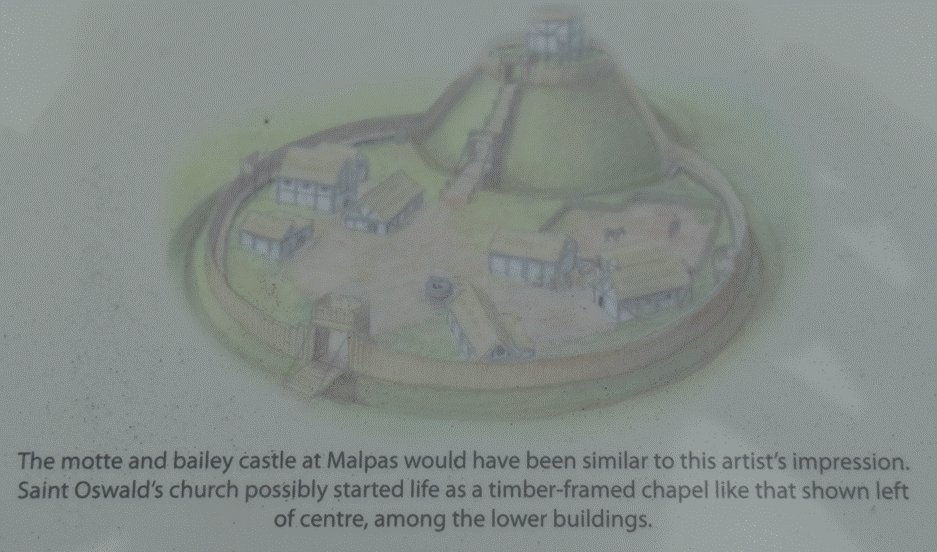
Robert FitzHugh oversaw the construction of Malpas Castle, a
timber motte-and-bailey fortification. Built on the highest knoll, it served as
the administrative and military head of the prestigious Barony of Malpas.
1086
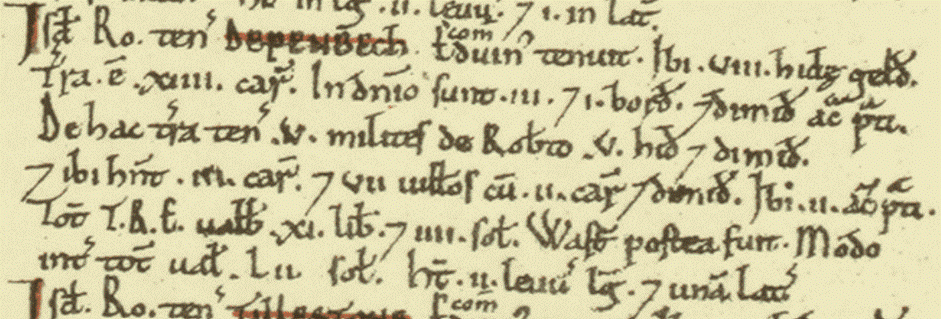
The settlement was surveyed and recorded in the Domesday Book
under its original Old English name, Depenbech, meaning deep brook.
The estate was confirmed as a holding of Robert FitzHugh. Malpas was a
settlement in Domesday Book, in the Hundred of Duddeston and the
county of Cheshire. It had a recorded population of 8 households in 1086,
putting it in the smallest 40% of settlements recorded in Domesday. (Powell-Smith, Anna, Malpas, Open Domesday).
Robert, son of Hugh, also called Robert FitzHugh, was a prominent
Norman baron and the first Baron of Malpas in Cheshire. Robert was recorded
holding roughly 30 to 43 townships and manors in Cheshire and along the Welsh
border (mostly cantered in the Hundred
of Duddeston), including Malpas, Christleton, Tilston, Cholmondeley,
Burwardsley, and Beeston.
1121
The name Malpas, derived from the Old French Mal-pas,
meaning bad or difficult passage was recorded around this year. The name
emphasised the hazardous, wild terrain and its vulnerability to Welsh
cross-border raids. Around this time, a planned town began to develop in the
bailey directly outside the castle walls.
1252
David de Malpas
In the mid thirteenth century, the Barony of Malpas
became a legal and genealogical tangle involving illegitimate succession,
strategic marriages, and divided estates.
David de Malpas, David the Bastard, was the
natural but illegitimate son of Sir William de Malpas and Beatrix de Montalt.
Upon his father's death around 1252, David successfully intruded himself into a
moiety, a 50% share, of the Barony of Malpas. He did this to the exclusion of
the rightful heirs in law, such as his uncle Philip Goch de Egerton. He
married Constance, daughter of Owain Cyfeiliog, Prince of Powys. David served
as the Sheriff of Cheshire in 1252 but died shortly thereafter, around 1255 to
1260. Because his possession of the estate was legally precarious, his death
triggered the formal splitting of his lands.
1257
The collection of tolls
On 20 September 1257 a grant was given to the
bailiffs and good men of Wyz Maupas, in consideration of the frequent passage
through that town and the losses and hindrance suffered by passengers through
default of repair of the bridges thereof, of pontage for five years from
Michaelmas, to wit, on every cartload of brushwood or other goods for sale
brought to the town ¼ d, a week, and on every horseload of the like, 1d a week.
(Patent Rolls of the reign of Henry
III, 1247
to 1258, page 579).
Wyz or Wich was the Anglo-Saxon
suffix used to denote a place associated with salt production or a brine
spring. In Cheshire, the famous salt-producing towns were referred to as the Wiches
(such as Nantwich, Northwich and Middlewich). The Norman name, Maupas, or
Malpas was derived from the Norman-French Malus Passus meaning bad
pass or difficult crossing. The Barony of Malpas held an
administrative share of Nantwich during the medieval period, leading
contemporary royal clerks to record the town as Wich Malpas, rendered in
Anglo-Norman French as Wyz Maupas, to distinguish it from the other salt
towns.
The 1250 grant mentioned was a temporary right to collect
tollages, or a variant of pontage or murage, specifically
intended to help the townspeople maintain and repair its crucial river bridges,
which were heavily burdened by travellers and merchants crossing the region.
1260
Because David de Malpas died without legitimate male heirs, his
seized moiety of the Malpas estate was partitioned around 1255–1260 between his
two daughters and co-heiresses: Beatrice and her sister, Idonea. Beatrice inherited
a one-fourth share of the Barony of Malpas. Beatrice first married William
Patrick, son of Robert Patrick, who already held an ancestral claim to a
portion of the barony. This marriage consolidated their regional power. William
died around 1279 in Shocklach, Cheshire.
Beatrice
later married Rhodri ap Gruffudd, the younger brother of Llywelyn the
Last, the Prince of Wales. As a daughter of David
de Malpas, her marriage brought land and property in Cheshire, including
portions of Malpas, into the possession of Rhodri. Rhodri held her
Cheshire estates jure uxoris, by right of his wife, until her death.
William Patrick and Beatrice had a daughter, Isabel
Patrick.
Late
thirteenth century
The Barons of Malpas were granted extensive legal powers,
exercising capital jurisdiction within the limits of the barony. They held the
hereditary office of serjeant of the peace for nearly the entire palatinate of Cheshire.
Under local custom, capital punishment was carried out by decapitation, and the
severed heads of felons were routinely presented at Chester Castle.
It appears that the barons of Malpas possessed
at that period a capital jurisdiction within the limits of their barony, and
also that their punishment, contrary to what has been usually stated, was
inflicted by the gallows. The beheading, called in old documents
the custom of Cheshire, was part of another jurisdiction, possessed indeed by
the Suttons and St. Pierres, but possessed by them not as barons of Malpas, but
serjeants of the peace of Cheshire in fee. (Ormerod, George (1882 revision) History of the County
Palatine and City of Chester, Volume 2, page
330).
1281
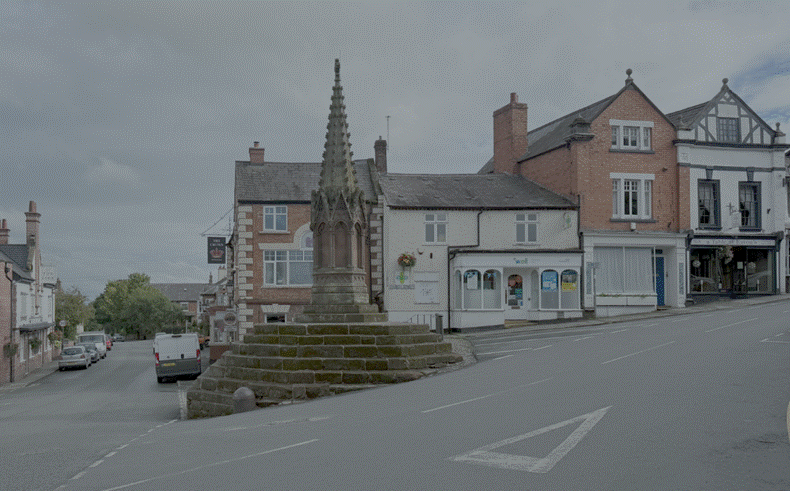
Malpas experienced an economic boom. It was granted a Royal Market
Charter allowing the town to hold a weekly market and an annual fair. The marketplace
established itself around the town cross. To accommodate expansion, nearby
agricultural strips were converted into burgage plots for local craftsmen and
traders to rent.
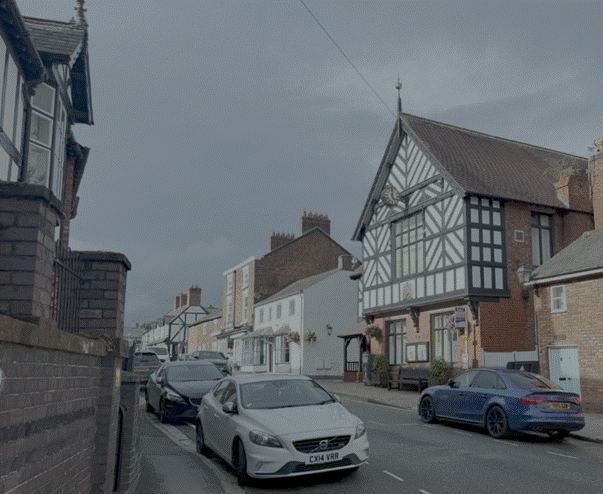
As the westernmost hundreds of Cheshire were politically detached
to form parts of Wales, Malpas increased in strategic value. It became the most
critical and prominent settlement in the southern half of the Broxton Hundred.
1282
The manor of a certain
William Gerberd was part of the honour of Malpas. An honour in medieval
England was a massive estate or cluster of manors held by a major
tenant-in-chief. On 10 August 1282, in the Inquisition on William Gerberd the
Younger of Burewardescote, the manor held of William Gereberd his father,
rendering 20 marks yearly to him, and 6 marks to Ealph de Wile … for the life
of the said William, who held part of the manor of the said Ralph, and the rest
of the Lady Isabel Patrich, who held of Isabel late the wife of Philip Burnel,
of the honour of Malpas (Malo Passu), and she held of the king in chief. (Calendar of Inquisitions Post
Mortem, Volume 2, (Edward I, 1272 to 1291),
Folio 453). The entry shows how local families
like the Gerberds were connected through a web of landlords (Patrich and
Burnel) to the great barons of Malpas, who answered directly to the
Crown.
1289
The split Manor
Beatrice died in 1289.
In the Inquisition on Beatrice, late the wife of Roderick son of
Griffin on 10 June 1289 (a legal inquiry held after the death of the wealthy
landowner, Beatrice, to establish what lands she held, what they were worth,
and who the rightful heir was), her estate included at Malpas (Malo Passu), a
fourth part of the manor, with a moiety of the serjeanty and a fourth part of
the advowson of the church. (Calendar of Inquisitions Post Mortem, Volume 2, (Edward I, 1272 to 1291),
Folio 749). Beatrice held one-quarter of the
manor of Malpas. During this period, the great barony of Malpas had become
split among different co-heiresses. This entry confirms that Beatrice's estate
retained her quarter-share.
By this time the massive Barony of Malpas
was split among co-heiresses. Idonea de Malpas had married the elder Urian de
St. Pierre. Her marriage brought a quarter of the Malpas barony into the St.
Pierre family.
When her mother Beatrice died it was
legally established that Isabel, then aged 30 and married to Richard de Sutton,
was Beatrice's next rightful heir. Through Isabel, the Sutton family, later the
Barons Dudley, acquired massive holdings in Cheshire.
In the Inquisition on Hugh de Pulford on 8 February 1289 on the
complaint of Robert son and heir of the said Hugh, that the escheator at the
procuration of certain rivals of his, asserting that they were held of the king
in chief, had taken into the king's hand lands, &c. it was recorded
that Both held of the heirs of William Patrik by service of 1/8th
knight's fee, doing suit at the court of Malpas (de malu passu), drink for the
Serjeants of the said heirs, and work at their castle and mill. (Calendar of Inquisitions Post
Mortem, Volume 2, (Edward I, 1272 to 1291), Folios 782).
There was a conflict regarding
who truly controlled Hugh's lands, the King of England or the local lords of
Malpas, and outlined the medieval obligations owed to the Malpas estate.
This entry is significant for
Malpas because it explicitly details the feudal rights, power, and infrastructure
of the Barony of Malpas at the end of the thirteenth century. The inquiry legally confirmed that
Hugh de Pulford's lands were not held directly from the King (in chief).
Instead, they were held under the heirs of William Patrik, who was one of the
historical barons of Malpas. The tenants of these lands were legally required to do suit,
attend and participate, at the manorial court of Malpas. This reinforced Malpas
as the central seat of legal and administrative power for the surrounding area.
The entry also evidences the existence and the active upkeep of
two important medieval structures in the town, Malpas Castle and the local
mill. The tenants were bound by feudal law to provide physical labour to
maintain them.
The requirement to provide drink for the Serjeants refers
to puture, a customary feudal obligation where local tenants had to
provide food, drink, or lodging to the bailiffs or law enforcement officers, Serjeants,
of the peace guild, maintaining the security apparatus of the Malpas barony.
1294
In the Inquisition on Urian de Sancto Petro, he was recorded to
hold two burgages, and two saltpits in Fulwich, held in free socage of
Richard de Sutton by service of 21d. and a pair of gloves (sorothecnrum) yearly
at Malpas. It was also recorded that Urian, son of John de Sancto Petro son
of Urian aforesaid and heir of the aforesaid Idonea, aged 16 at the feast of
St. Dunstan last, is next heir of Urian aforesaid (Calendar of Inquisitions Post Mortem, Volume
3,
(Edward I, 1291 to 1300), Folios 281,
see also 376).
The entry mentions two saltpits in Fulwich. Salt production at the
wich towns was the economic engine of medieval Cheshire. Having saltpits
tied directly to the Malpas burgages emphasized how crucial the salt trade was
to the wealth and localised economy of the Malpas lords.
The requirement of a pair of gloves, sorothecarum, as part
of the annual service at Malpas was a nominal or quit-rent customary in
free socage. It was a ceremonial token used to establish lordship and legal
superiority without demanding costly military or labour services.
Sir Urian de Sancto Petro, also anglicised to Sir Urian de St.
Pierre or Sampier, was a prominent Marcher
Lord, and landowner whose family held extensive estates in Cheshire,
Shropshire, and the Welsh Marches. He
lived from roughly 1216 until his death in early 1294. Urian
had elevated his family's status considerably by marrying Idonea de Malpas
before 1257, one of the co-heiresses to the vast Barony of Malpas. Through this
marriage, Urian gained jure uxoris, a one-quarter share of the barony,
including the lands, saltpits, and customary rights mentioned in your original
inquiry.
1297
Robert de Hemmington and William Dujn, parsons, each shared a
moiety of the church of Malpas (Patent Rolls of the reign of Edward I, 1292
to 1301, pages 285,
286).
1327
A Snapshot in time in the
history of Malpas
John, son of Richard de Sutton, was granted royal
permission to transfer several properties held directly from the King, held
in chief. The properties were the castle of Malpas; the manor of Shokkelach,
Shocklach; the advowson (right to appoint the priest, of Malpas church;
and the reversionary right to the manor of Yayton, so that ownership would
transfer after the death of the current life tenant, Robert de Sutton. To
secure the family's long-term inheritance, John uses a common medieval legal
loophole called enfeoffment to uses by transferring the properties
through intermediaries.
Licence for John son of Richard de
Sutton to enfeoff Henry de Warrewyk, chaplain, and Thomas de Hampstede, of the
castle of Malpas, the manor of Shokkelach and the advowson of the church of
Malpas, held in chief, and the reversion of the manor of Yayton, also held in
chief, after the death of Robert de Sutton, the tenant for life ; and for the
said feoffees, after seisin had, and upon attornment by the said Robert, to
re-grant the premises to the said John and Margaret, his wife, for their lives,
with remainder in fee tail to John son of John son of Richard de Sutton, and
Isabella, his wife, daughter of John de Cherletoii, and ultimate remainder to
the right heirs of the said John son of Richard de Sutton (Patent Rolls of the reign of Edward III, 1327
to 1330, page 97).
Sir Richard de Sutton (c 1266 to c 1346) was originally a
prominent landowner in Nottinghamshire, holding the manors of Warsop, Sutton,
Eakring, and Cotham. However, his status expanded dramatically into Cheshire
through his marriage in 1284 to Isabel Patrick. Isabel was the daughter of
William Patrick and Beatrice de Malpas. Through her mother, Isabel was the
co-heir to the ancient and powerful Barony of Malpas. By 1300, Richard was
recorded by the Crown as holding a significant portion of Malpas and Shocklach.
He laid the foundation for the family's immense wealth by consolidating these
strategic Cheshire lands, which he later passed down to his son, John.
Sir John de Sutton I (c 1286 to 1338) was
the son of Richard and Isabel. He inherited the Malpas and Shocklach estates
from his mother's side, but he gained further power through his own marriage to
Margaret de Someri. Margaret was the sister and sole co-heir of
John de Someri, the last Baron Someri. When her brother died without children
in 1321, Margaret inherited vast estates, most notably Dudley Castle in
Staffordshire. In her right, John became the Lord of Dudley Castle. John
lived through the chaotic reign of King Edward II. He was an ally of his brother-in-law,
John de Someri, and was heavily involved in the Scottish Wars. However, he was
accused of backing the rebellion of Thomas, Earl of Lancaster, against Edward
II. Because of this, he was imprisoned in the Tower of London and extorted into
signing away his rights to Dudley Castle. When Edward II was deposed and Edward
III took the throne in 1327, John was freed, and his stolen lands were
completely restored to him.
This patent roll entry from 1327 captures John at the moment of
his political restoration. Fresh out of prison and with his lands secured under
the new king, he immediately set about executing the enfeoffment process
to legally lock down his family’s inheritance for his wife Margaret, his son
(John II), and his daughter-in-law Isabella de Cherleton.
The Dod family, who resided at Edge Hall
just two miles north of Malpas, were part of the bedrock of the local
community. By contrast, the de Suttons were their newly elevated, high-status feudal
superiors who held the actual Barony of Malpas. The patent roll entry records
that John de Sutton held the castle and manor of Malpas in chief,
directly from the King. Edge was nestled inside the broader parish and Barony
of Malpas, so the Dods would have legally held their estates at Edge under the
ultimate feudal lordship of the Barons of Malpas. When John de Sutton or his
bailiffs held the local manorial courts or demanded feudal dues, the Dods would
have been required to show their allegiance, attend the courts, or provide
localised military service. Roger Dod of Edge,
who married Mabel Mere around 1324, was the head of the Dod family at this
time. Edge was a
township in the parish of Malpas (see for instance Malpas, the National Gazetteer of Great Britain and Ireland,
1868). The Dod family worshipped, baptised their children, and were
buried at the church of St Oswald's in Malpas.
The Dods were fiercely local. They were an ancient, native
Anglo-Saxon line, descended from Cadwgan Dot or Hova Dod, who managed to
survive the Norman Conquest and clung stubbornly to their small estate at Edge.
They were deeply rooted in the soil of Cheshire. The de Suttons were
broad-horizon aristocrats. While Sir Richard de Sutton had acquired the Malpas
lands by marrying the Cheshire heiress, Isabel Patrick, the family’s focus was
rapidly shifting. Because John de Sutton married the Someri heiress and
inherited Dudley Castle in Staffordshire, the de Suttons were becoming national
politicians and Marcher barons. They
spent very little time at Malpas Castle, leaving the day-to-day management of
the area to local families like the Dods.
Just months before the 1327 patent roll entry, England experienced
a historic coup. Roger Mortimer, the ultimate Marcher Lord of Wigmore and
Ludlow, had escaped from the Tower of London, teamed up with King Edward II’s
estranged wife, Queen Isabella, and launched a successful invasion of England.
In January 1327, they forced King Edward II to abdicate the throne in favour of
his 14-year-old son, Edward III. Because Mortimer and Isabella became the de
facto rulers of England, the Welsh Marches became an important centre of
national power. Local lords who had previously been imprisoned or stripped of
their lands by Edward II, including John de Sutton, were suddenly released,
vindicated, and given their properties back.
The deposed King Edward II. He was moved around various Marcher
fortresses before being imprisoned at Berkeley Castle, just down the River
Severn from Chester and the Marches. On 21 September 1327, it was announced to
the public that the former king had died in captivity. Some
chronicles claimed he died of a broken heart; others spread the legend that he
was assassinated with a red-hot poker. Modern historians even debate whether
his death was faked by Marcher lords, sparking local underground plots by local
knights trying to break him out of prison. For families like the Suttons and
the Dods, the ghost of the old king was dominating local gossip.
1328
The in the following year, on 10 May 1323, Licence for
John son of Richard de Sutton to enfeoff Master John de Hildesleye, clerk, and
Peter de Rythre, clerk, of the castle of Malpas and manor of Shokkelath, and of
the advowson of the church of Malpas, held in chief, and to grant to them his
reversion in fee simple to the manor of Yeyton, held in chief, which Robert de
Sutton holds for life of the inheritance of the said John son of Richard : and
licence to John de Hildesleye and Peter de Rythre, upon seisin and attornment,
to grant them to John son of Richard and Margaret, his wife, for their lives,
with remainder to John son of John son of Richard de Sutton and Isabella, his
wife, daughter of John de Cherleton, in tail, with remainder, if they should
die without issue, to the right heirs of John son of Richard. Changed, because
at another time sealed by writ of privy seal. and Licence for John son
of Richard de Satton to enfeoff Master John de Hildesleye, clerk, and Peter de
Rythre, clerk, of the castle and hundred of Malpas, and the manors of
Shokkelach, Bradeley, Ageton, a moiety of the manor of Chirchecristelton, of
three parts of the manors of Overesolwych and Nethersolwych, a moiety of the
third part of the mill of Barton, a fourth part of the manor of Rowecristelton,
and the serjeanty of the peace of Malpas, co. Chester, and of three parts of
the advowson of the church of Malpas, held in chief, and to grant them his
reversion in fee simple to the manor of Teyton, of which Robert de Sutton is tenant
for life, of the inheritance of John son of Richard ; and licence for John and
Peter to grant the first named premises to John de Gherleton, for life, with
remainder to John son of John son of Richard de Satton and Isabella, daughter
of John de Cherleton, in fee tail, with remainder, if they die without issue,
to the right heirs of John de Cherleton ; and the manor of Yeyton, when they
have received attornment of Robert de Sutton, to John de Cherleton in fee
simple. and a similar entry Altered because sealed at another time.
(Patent Rolls of the reign of Edward
III, 1327
to 1330, pages 269,
273,
331,
332).
1344
On 27 April 1344 in the church of Friars Preachers at
Rothelan, Sir Richard de Sutton did fealty and homage for the barony of Malpas
(Patent Rolls of the reign of Edward
III, 1343
to 1345, page 231).
The church of the Friars Preachers referred to the Dominicans in
Rhuddlan, Denbighshire, in North Wales; Rothelan was an Anglo-Norman
spelling for Rhuddlan. Medieval religious houses in the Welsh Marches served as neutral
grounds for legal, military, and political administration. Because the Malpas
lands straddled the volatile English and Welsh border, performing feudal
ceremonies including homage and fealty inside a respected, royal-sanctioned
religious house like Rhuddlan Friary provided a mutually agreeable, sacred, and
legally binding environment.
1347
The Breretons of Malpas
The Brereton family
inherited their share of the Barony of Malpas through a strategic marriage,
followed by a bitter legal battle that successfully overturned a rival branch's
claim to the estate. The foundation of the inheritance was laid when Sir William
Brereton (the grandfather of the William mentioned in the patent roll) married
Elena (or Ellen) de Egerton in about 1347 to 1349. Elena was the daughter of
Philip de Egerton and, crucially, the sister and eventual co-heiress of David
de Egerton, who held a moiety (a half-share) of the ancient Norman Barony of
Malpas. Egerton died without any
children of his own. His legal heirs were his two sisters, Elena (who married
Brereton) and Isabella (who married Sir John de Delves). The inheritance was
not straightforward. A rival claimant, David de Malpas, historically known in
legal records as David the Bastard (see entry for 1252 above), had seized
control of the Malpas lands. Elena's sister, Isabella Delves, launched a fierce
legal challenge to wrest the estates back from David the Bastard's descendants.
She was successful, and because Isabella died without children, her entire
share reverted back to her nephew, the younger Sir William Brereton, the chivaler"
who died in 1425 (4 Henry VI).
Through this dual descent,
the Breretons secured a significant portion of the Malpas estates, establishing
two prominent lines. The Breretons of Brereton Hall were the senior line,
descending from Sir William’s first wife, Elena Egerton, and they retained the
core manor lands. The Breretons of Malpas were a highly influential junior
branch founded by Sir Randal Brereton, the son of Sir William's second
marriage, who established a seat at Malpas Castle and went on to serve as
high-ranking royal courtiers to Henry VII and Henry VIII. (Brereton, John (1919), Brereton,
A Family History, San Francisco).
c 1350 to 1400
With the Welsh borders gradually stabilising, the military role of
Malpas Castle ebbed. Malpas Castle was largely obsolete by the late medieval
period and fell into ruin by the sixteenth century.
By the nineteenth century, The Castle of Malpas, the original
head of the barony, as well as the later castle of Shocklach, has long been
destroyed. Like all the other Cheshire fortresses on the Welsh border, it was
situated immediately adjacent to the church, which it most probably
comprehended within its antient works. The only remains consist of the circular
mound of the keep on the north side of the church, measuring about 40 yards in
diameter on the summit, and considerably elevated above the level of the
church-yard. In some recent alterations, the ditch was traced to a considerable
depth by the variation between the natural soil and the mud which has
accumulated in it for centuries. (Ormerod,
George (1882 revision) History of the County Palatine and City of Chester,
Volume 2, page
330).
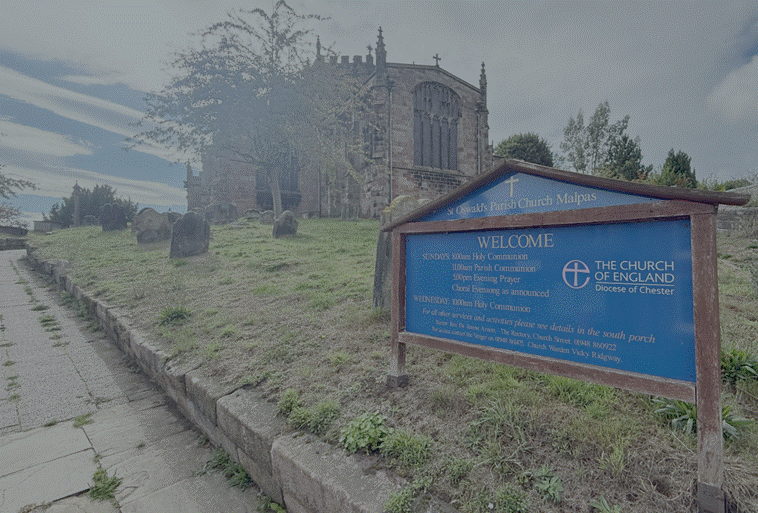
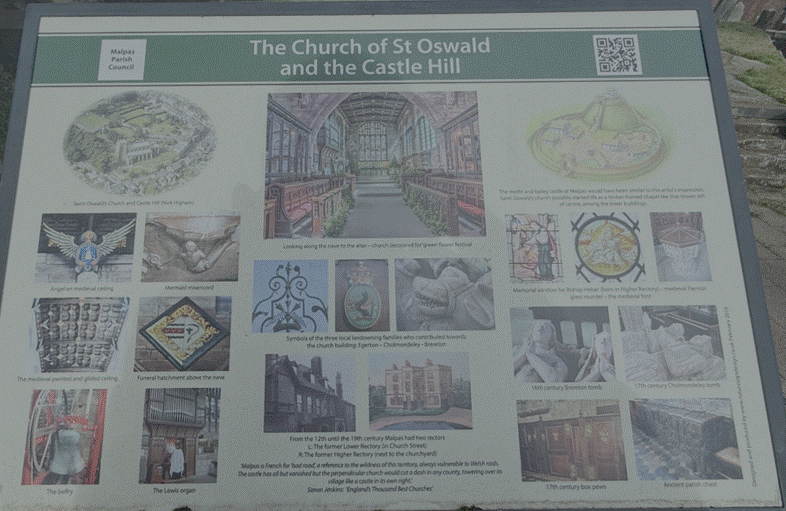
In the second half of the fourteenth century, construction began
on the grand, red sandstone Church of St. Oswald. It was built directly
adjacent to, and partially over, the old castle earthworks, probably
incorporating the footprint of the original castle chapel.
1378
On 24 October 1378 at Gloucester, there was recorded the Ratification
of the estate of Master John de Cudyngton as parson of a moiety of the church
of Malpas, co. Chester (Patent Rolls of the reign of Richard II, 1377
to 1381, page 278).
1389
On 2 October 1389 at Westminster there was recorded the Presentation
of William Cristendome, king's clerk, to a mediety of the church of Malpas in the
diocese of Coventry and Lichfield. (Patent
Rolls of the reign of Richard II, 1388
to 1392, page 111).
1390
On 18 May 1390 it was recorded at Westminster that John de
Halsham and Philippa, his wife, staying in England, have letters nominating
James Boteler, earl of Ormonde, and Nicholas Perfet, their attorneys in Ireland
for one year. Hugh, parson of Malpas, received the attorneys by writ. (Patent Rolls of
the reign of Richard II, 1388
to 1392, page 247).
The wealth and power of the rectory
Thomas de Delves, late parson of Malpas was the rector or parson
of Malpas prior to 1390. In medieval Malpas, the rectory was divided into two shares
(moieties), the Higher Rectory and the Lower Rectory. Each lord of the divided
barony held the advowson, the highly lucrative legal right to nominate (present)
a priest to their respective half of the church.
On 17 June 1390 at Westminster it was recorded that Whereas
Henry de Coton, late parson of Cubbeley, has long sued for restitution of the
manor of Aber in North Wales and the advowson thereof, showing how Thomas de
Delves, late parson of Malpas, and he, by fine, acquired it from Walter Manny,
knight, to hold to them and the heirs of the said Thomas, by virtue of which
fine they continued their estate therein all the life of the said Thomas, and
after his death the said Henry his estate until after the death of John Delves,
knight, it was seized into the hands of the late prince, the king's father, by
virtue of an inquisition taken before Hugh Coly, escheator in North Wales, by
which office it was found that the said John died seised thereof and held it of
the prince in chief, whereas he never held it in demesne but only at the will
of the said Thomas and Henry ; the said Thomas dying without heir of his body,
the manor descended to the said John as his brother and heir, and the said John
dying without heir of his body, it descended to Henry de Delves, his surviving
brother and heir, and is now by special grant of the king queen Anne's for life
; the king, considering the right claimed by the said Henry de Coton, by advice
of the Great Council, has granted to him, for life, the manor of Walton upon
Trent, co. Derby, with its appurtenances, the advowson of its church, with
knights' fees, wardships, marriages, relief, escheats, franchises and
liberties, and all other things belonging to the manor, with remainder, in fee
simple, to Henry de Delves, in recompense for the aforesaid manor of Aber, and
in return the said Henry de Coton and Henry de Delves, brother and heir of the
said John, have released and quit-claimed to the king all their interest in the
manor of Aber and in the towns of Penmayn and Lassemayn in North Wales, with
knights' fees, advowsons, fairs, markets and warrens and all other
appurtenances, the raglorship and woodwardship of Arthelewak Ughap and la Frith
of Nantmawan, Nanheskele and Ycras with the avowries (hauotriis) of Meuryn,
Nanteracadrac and all else thereto belonging; and because the manor of Walton
is charged with 10 marks a year to Thomas Sy and William Gold, yeomen of the
king, payable to each of them for their lives, the king wills, with the same
assent, that whilst it is so charged full compensation in some suitable place
be made to them and the heirs of Henry de Delves (Patent Rolls of
the reign of Richard II, 1388
to 1392, page 263). Thomas
de Delves was not just a local priest; he was a well-connected landowner acting
in partnership with high-ranking figures like the prominent military commander
Walter Manny. The Delves family were major landowners in Cheshire and
surrounding areas, including the manor of Doddington, and had immense wealth
and regional influence. Thomas de Delves held the rights to the manor of Aber
in North Wales, with the property set to inherit through his personal heirs.
Because Thomas died without children (without heir of his body), his
estate, including these external properties, descended to his brother, John
Delves, knight, and subsequently to their surviving brother, Henry de Delves.
This illustrates how the wealth generated or held by Malpas’s
clergy often fed directly back into the estates of powerful Cheshire gentry
families.
The entry connects Malpas to the highest levels of government in
fourteenth-century England. The dispute over the lands involved King Richard II,
his consort Queen Anne (of Bohemia), and the Great Council at Westminster. The
rector of Malpas was operating in a sphere of elite real estate transactions
that required royal intervention, land swaps (such as receiving Walton upon
Trent in Derbyshire as compensation), and formal quit-claims to settle crown
disputes.
A Dispute with the King, 1390 to 1392
Prior to the dispute, John de Hynkeley had been formally presented
as the priest of Malpas on 10 September 1384 by Lord John de Sutton, the lord of
Malpas. In the late fourteenth century, the Barony of Malpas was fractioned,
with families like the Suttons, Egertons, and later the Breretons holding or
claiming multi-quarter stakes in the local manor lands and church patronages.
The right of advowson was treated as a valuable property asset because
it allowed the patron to award a lucrative ecclesiastical living, complete with
local tithes and land revenues, to a preferred candidate. Between 1390 and
1392, Richard II attempted to intrude upon this regional patronage by
challenging the traditional rights of the local lords and asserting the Crown's
right to present its own royal clerks to the Malpas benefice. This was part of
a broader political strategy by Richard II to consolidate royal authority in
Cheshire, a region he heavily relied upon for personal power and military
support. The local community, including the incumbent priest John de Hynkeley
and local landowners, fiercely resisted the Crown's intervention. Such disputes
frequently escalated. Under laws established since the reign of Henry II,
disputes over advowsons were handled in secular courts rather than
church courts. This allowed the King's bench to heavily pressure local gentry.
The people of Malpas and their regional lords wished to maintain a priest from
their immediate community rather than a crown-appointed clerk who might act
primarily as a royal tax collector or absentee official. While Richard II
frequently attempted to override local feoffees during his reign, local
families in Malpas systematically used legal manoeuvring, land feoffments, and
marital alliances to continuously shield and recover their traditional stakes
in the parish church from royal overreach.
On 26 November 1390 there was granted Commission to the justice
and chamberlains of Chester, and the persons supplying their places, to arrest
and imprison until further order all impugners of the king's right to present
William Cristendome to a moiety of the church of Malpas, he having been duly
admitted, instituted and inducted, but prevented from collecting the emoluments
thereof, and all who so disturb his possession of the same ; and of this they
are to make public proclamation at Malpas and elsewhere in the county, as they
deem fit. (Patent Rolls of the reign of Richard II, 1388
to 1392, page 351).
By October 1389, Richard II had stepped in to assert a royal right
to fill a vacancy in one of the moieties at Malpas, appointing a clerk named
William Cristendome. While Cristendome had gone through all the formal legal
and religious ceremonies (he was admitted, instituted and inducted), he
had faced immediate, aggressive local resistance. He was prevented from
collecting the emoluments thereof. In the fourteenth century, being a
rector was a major source of wealth derived from tithes, local
agricultural taxes, land rents, and fees. Local factions or rival claimants to
the barony were physically or financially blocking Cristendome from receiving
this income, likely arguing that the King had overstepped his bounds and
usurped their traditional right to name the priest. Because
Malpas sat within the Palatinate of Chester, a region with its own distinct
legal system under the Crown, the King took drastic measures to enforce his
will. Instead of letting the matter wind through slow ecclesiastical courts,
the King issued a direct military and judicial mandate to his principal
regional enforcers: the Justice and Chamberlains of Chester. They were granted
sweeping powers to arrest and imprison indefinitely impugners who
questioned the King's appointment or harassed Cristendome. They were also to
make public proclamations at the Malpas market cross and throughout the county
to publicly shame the opposition and loudly re-assert that the Crown controlled
the church.
In short, Malpas was experiencing a localised but high-stakes
standoff where the Crown used the threat of imprisonment to crush local gentry
resistance over church revenues and patronage power. This occurred before
Ricjhatrd II’s tyranny (1397 to 1399), during a period when the king was still
reigning through moderation and cooperation. Yet medieval kings viewed Cheshire
as a Royal Palatinate as essentially the King's personal domain. Even during
his quiet period, Richard
was actively building up Cheshire as a hyper-loyal military stronghold,
cultivating local gentry and creating a private army of Cheshire archers who
wore his personal badge, the White Hart. When locals in Malpas dared to resist
the King's appointment of William Cristendome, they weren't just defying an abstract
law; they were defying the King in his own backyard. Richard’s fierce reaction
in 1390 was not a symptom of the paranoia that characterised his later tyranny;
it was a firm, calculated reminder to the people of Cheshire that the Crown
expected total, unquestioning obedience in exchange for the local privileges
they enjoyed.
1392
On 29 May 1392 at Stamford and on 16 October 1392 at York, there
was recorded the Ratification of the estate of Thomas Hilton as parson of a mediety
of the parish church of Malpas in the diocese of Coventry and Lichfield (Patent Rolls of
the reign of Richard II, 1391
to 1396, page 66,
183).
Then on 26 February 1394 at Westminster there was a record of the Presentation
to R. bishop of Coventry and Lichfield, of Thomas de Hilton, for admission to a
mediety of the church of Malepas in his diocese, lately recovered in the King's
Bench against John de Hynkeley. (Patent
Rolls of the reign of Richard II, 1391
to 1396, page 373).
The last entry reveals that a dispute had arisen over who actually
owned the right to appoint the priest (advowson). The King’s lawyers
sued a local figure, John de Hynkeley, in the Court of King's Bench. The King
won the lawsuit and recovered the right, stripping Hynkeley of the
appointment power and allowing the King to present Thomas de Hilton instead.
1397
On 26 May 1397 at Westminster there was recorded the Ratification
of the estate of Richard Conyngston as parson of a mediety of the church of
Malpas (Patent Rolls of the reign of Richard II, 1396
to 1399, page 138).
1400
Revolution against Henry IV
On 22 May 1400 there was a
general pardon by Henry IV, following his usurpation of the Crown from Richard
II, to all the king’s lieges of the county of Chester for all treasons,
insurrections, felonies, rebellions and trespasses committed by them from Christmas
last to the Purification, except murders and rapes, but a number of men
were excluded from this general pardon including John Davidson leche of
Malpas; David Dodde; John del Malpas; Thomas de Grene of Malpas; Robert de
Sutton of Frodesham; and David Dodde of Egge. (Patent Rolls of the reign of Henry IV, 1399
to 1401, page
285 to 286).
This general pardon on 22
May 1400 was granted by Henry IV to suppress anti-Lancastrian unrest in the
County of Chester following the Epiphany Rising. The named individuals,
including John Davidson, David Dodde, and Robert de Sutton, were excepted
because they were identified as die-hard Ricardian loyalists, former members of
Richard II’s private Cheshire
Guard, or primary instigators of the local revolt who were forced to sue
for individual pardons.
When Henry Bolingbroke
usurped the throne from Richard II in autumn 1399 to become Henry IV, he
inherited a deeply unstable kingdom. No region was more hostile to his new
regime than Cheshire. Richard II had elevated Cheshire to a principality,
showered its gentry with titles and annuities, and recruited his infamous,
highly loyal personal bodyguard, the Cheshire Guard, directly
from the county. When Henry's invading forces marched through Cheshire in 1399,
they subjected the area to harsh retribution and violence.
In January 1400, a
conspiracy of counter-revolutionary nobles launched the Epiphany Rising to
assassinate Henry IV and restore Richard II. Simultaneously, an
anti-Lancastrian rebellion flared within Cheshire itself. Rebels attacked
Chester Castle and attempted to hold the county for the deposed king. The
rebellion failed, and Richard II died mysteriously, likely starved on Henry’s
orders, at Pontefract Castle in February 1400 to eliminate him as a focal point
for future revolts. By May 1400, Henry IV used a mix of tactical leniency and
intimidation to pacify the county: a general pardon designed to sweep up the
lesser offenders, restore basic legal order, and prevent Cheshire from
remaining an open hotbed of insurrection.
The Calendar of the Patent
Rolls lists over 100 men explicitly excluded from this blanket mercy. They were
isolated for three primary reasons. Some were core ringleaders and activists.
Rather than giving a free pass to the ringleaders who orchestrated the attacks
on Chester Castle, Henry's government singled them out to prevent immediate
immunity. Many of those excepted were former retainers, archers, and loyalist
elements of Richard II’s military affinity. Men from Malpas, Frodsham, and Edge
belonged to prominent local families that had heavily benefited from Richard
II's patronage. For example, the Suttons and Doddes were deeply embedded in the
county’s military structures. Being excepted from a general pardon did
not necessarily mean immediate execution. Instead, it meant these men were
compelled to sue for individual pardons.
By forcing men like John
Davidson, David Dodde, and Robert de Sutton to surrender independently, the
Crown achieved two goals. It forced them to formally acknowledge Henry IV's
legitimacy, and it required them to find financial sureties, large monetary
bonds, from their neighbours to guarantee their future good behaviour.
See McNiven, Peter, The
Cheshire Rising of 1400.
1428
On 15 September 1428 there
was a Presentation of Adam Irland, chaplain, to the parish church of Malpas
in the diocese of Coventry and Lichfield, void by the death of William Baxter,
late rector of the same (Patent Rolls of the reign of Henry VI, 1422
to 1429, page 501).
1438
William de Brereton,
grandson of Sir William de Brereton, chivaler or knight raised a petition.
When the grandfather died
around 1426, an official inquiry (inquisition) correctly found that he held
massive estates in Cheshire, but a clerk's mistake recorded the grandson's
birthdate incorrectly as 1425 (4 Henry VI) instead of 1423 (2 Henry VI). This
error made the grandson look like an underage minor (12 years old) when he was
actually older. Because
the records stated he was a minor, the King seized the lands into royal custody
(wardship) and collected all the estate profits, amounting to a massive £438
6s, until a later inquiry proved William was actually over 21 years old and
entitled to his inheritance. William petitioned the King at Windsor Castle
regarding the error. King Henry VI accepted the proof of his real age, granted
him official possession (livery) of his lands, and issued a royal pardon
forgiving any administrative issues or unlawful entries regarding the estate
and its past profits.
On 18 February 1438 there
was a petition presented at Windsor Castle by William de Brerton, son of de
Brerton, son of William de Brerton, ‘chivaler,’ it appears that inquisition
taken before John Wetenhale of Wiche Malbank, escb the county of Chester, on a
writ of diem clausit extremum, it was that the said William de Brerton,
‘chivaler,' died seised in his (as of fee of a fourth part of a moiety and of a
moiety of a fourth moiety of the manor of Malpas, and of a third part of the
Pikton, worth £40 a year, and of 11 messuages with lands a in Wordhull worth
£40 a year, 8 messuages with lands adja Croweton, worth 64s 2d a year, a
messuage and 40 acres of Wyrehall, worth 30s. a year, and a ‘wychehous,’ in
Northwich yearly value beyond the reprises ; and that he died on Sunday St.
Dunstan, 4 Henry VI, and that petitioner was his next heir a 12 years at the
Nativity of the Virgin. 4 Henry VI ; and thereupon premises were taken into the
king's hands, who had the profits amounting to £438 6s. until 18 September, 18
Henry VI, when was issued to the escheator of the said county to prove the age
of William, on which it was found by inquisition that he was 21 years and more,
having been born on the nativity of St. Mary, 2 Henry VI; by a clerk's mistake
he was returned as having been born on Wed the nativity of the Virgin, 4 Henry
VI, by an inquisition of eleven and by the former inquisition he obtained
livery of his lands; that on his petition, pardons him any entries made by him
into them 18 October, 18 Henry VI, with the mesne profits. (Patent Rolls of the reign of Henry VI, 1436
to 1441, page 138).
The Breretons of Malpas in
the Tudor Court
1476
On 16 November 1476 there was granted at Westminster a
Pardon to Ranulph Brereton, knight, of Malpas, co. Chester, late sheriff of
Stafford, of all offences committed by him and all fines, amercements, issues,
debts, accounts and arrears due from him to the king by reason of his office
(Patent Rolls of the reign of Edward
IV and Henry IV, 1467
to 1477, page 604).
In fifteenth century England, serving as a county Sheriff such as the Sheriff
of Staffordshire was a precarious and expensive duty. Sheriffs were responsible
for collecting the Crown's local revenues, tax arrears, and court fines. If
they failed to collect the full amounts due, or if their accounting records
were disputed during the strict audits at the King's Exchequer, they became
personally liable for the debts, amercements (judicial fines), and
arrears. A royal pardon of all offences, fines, and arrears
did not necessarily mean Sir Ranulph committed a crime. Instead, it functioned
as a vital official discharge. It cleared his personal ledger with the Crown at
the end of his term, ensuring the King could not seize his lands or imprison
him for outstanding administrative debts.
The Breretons of Malpas,
Cheshire, were one of the most powerful and influential gentry families in the
region. By successfully securing this discharge, Sir Ranulph protected his
ancestral estate in Malpas. Sir Ranulph's immediate successor, Sir Randolph
Brereton, used the family's protected wealth and growing court influence to
fund extensive, late fifteenth century renovations to St Oswald's Church,
Malpas. This included building the magnificent Brereton Chantry Chapel inside
the church, where several generations of the family are buried.
The landowners of Malpas were
not merely isolated border lords. They were powerful administrators operating
across county lines, from Cheshire to Staffordshire, and commanding direct
legal influence at the royal court in Westminster.
1480 to 1500
The church of St Oswald underwent extensive reconstruction; side
walls of the nave were demolished down to the windowsills to install much
larger windows, a clerestory was added, and the famous timber panelled roof
with gilded bosses and carved angels was installed alongside unique misericords.
The Church of Malpas is a handsome specimen of
the enriched Gothic of the later part of the reign of Henry VII, and consists
of a low tower, nave, chancel, and side aisles, which terminate in two chancels
erected by the Cholmondeleys of Cholmondeley, and Breretons of Shocklach and
Malpas Hall. The windows are large and well calculated for a brilliant display
of that essential accompaniment of Gothic architecture, with which the taste
and piety of earlier ages decorated the Cheshire churches in profusion. They
are, however, too large to be filled, as they now are, with common glass, and
cast a cold and cheerless air of nakedness on the whitewashed walls. (Ormerod, George (1882 revision) History of the County
Palatine and City of Chester, Volume 2, page
343).
1520
Roger Brereton, of Westminster, alias of
Malpasse, Cheshire was granted a Pardon for the murder of
Richard Tilston at Westminster, delivered in Westminster on 25 April 12 Henry
VIII (Public Records of the reign of Henry
VIII, Volume 3, Part 1, Folio 779).
Roger Brereton was a member of the powerful Brereton family, the fourth son of
Sir Randle Brereton, who served as Chamberlain of Chester. Roger held positions
at court and later became an influential figure in Welsh Marches and Cheshire
administration. Richard Tilston was a member of another
prominent Cheshire gentry family from Huxley/Hatton, closely interconnected
with local landholdings.
The murder took place around 1518 before the altar of a chapel
inside the Palace of Westminster. Committing an act of violence or murder
inside a royal chapel, particularly at the altar, was a severe breach of both
the King's peace and religious sanctuary, carrying deep sacrilegious weight.
Despite
the shocking nature of a murder at a Westminster altar, Brereton’s status,
court connections, and his family’s immense influence under Henry VIII allowed
him to secure a formal royal pardon. Rather than ruining him, he went on to
hold several prominent regional offices, including serving as a Member of
Parliament and Sheriff later in life.
1532
There was a royal pardon and ratification issued by King Henry
VIII in September 1532 to the high-ranking clergyman, Master John Brereton
which legalised his right to simultaneously hold multiple lucrative church
offices, including the parish church of Malpas, despite strict legal
restrictions against doing so.
Master John Brereton, canon of London, doctor of decrees. Pardon
for having obtained a bull, dated at St Peter’s, Rome in 1531 authorising
him, if the mastership or custody of the St Augustine hospital of St
Bartholemew, in West Smythfeld, near and against the walls of London, should be
committed to him (which mastership or custody was lately held in commendam by
Edward Staple, bishop of Meath, by Apostolic dispensation, and is now void), to
hold the same in commendam, along with other incompatible benefices, the said
John being then priest and chaplain of King Henry VIII, canon and prebendary pf
St Paul’s London, and St Stephen’s, London, and having obtained by dispensation
the parish churches of Malpas and Cristelton, Coventry and Lichfield diocese.
This patent also ratifies the bull and allows the said John to publish the
same, and put it into execution. (Public
Records of the reign of Henry VIII, Volume
5, Folio g
1370 (13)).
John Brereton’s ability to secure the wealthy living of Malpas,
alongside his high status in London and the King's court, evidences how the
Brereton family leveraged church appointments to consolidate their wealth and
regional influence. Because Brereton was heavily active in London
as a canon, doctor of decrees, and royal chaplain, it he will have been an
absentee rector for Malpas. He likely lived in London, collected the tithes and
financial yields from Malpas, and paid a poorly compensated local curate to
handle the actual spiritual duties in the parish.
In 1532, Henry VIII was in the middle of his dispute with Rome over
his annulment from Catherine of Aragon. Only a year or two later, Henry would
completely break from the Catholic Church, pass the Act of Supremacy, and ban
all Papal Bulls entirely. This record shows that in late 1532, the old system
was still functioning. English priests were still buying dispensations from
Rome, and the King was still willing to ratify them for his favoured court
chaplains.
1536
The Lands, &c. of William Brereton, Esquire in the Account
for the year ended Michaelmas last 27 Henry VIII, included gift of Sir
Randall Brereton, his father, lands in Malpas, &c., of the annuity of
William Brereton Esq 64s 1d. (Public Records of
the reign of Henry VIII, Volume
10, Folio 878
iii bis).
Bibliography
Crossley, Fred H, and Wolley Dod, JC (1949), An Architectural History
of the Church of Malpas in the County of Cheshire.
Hayns, David (2016), Malpas: Cheshire’s Town in the Marches.
Kenyon, William (First published 1895; 3rd edition 1914; facsimile
reprint by Malpas Field Club, 1995), Malpas: Parish, Town and Church.
Ormerod, George (1882 revision) History of the County Palatine
and City of Chester, Volume 2, pages
328 to 347.