John
the Miller of Farndale
c
1256 to c 1330
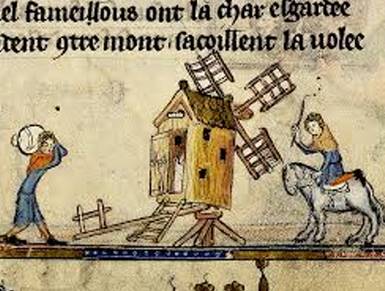
FAR00021B
|
Return to the Home
Page of the Farndale Family Website |
The story of one
family’s journey through two thousand years of British History |
The 83 family lines
into which the family is divided. Meet the whole family and how the wider
family is related |
Members of the
historical family ordered by date of birth |
Links to other pages
with historical research and related material |
The story of the
Bakers of Highfields, the Chapmans, and other related families |
Dates are in red.
Hyperlinks to
other pages are in dark
blue.
Headlines are in brown.
References and
citations are in turquoise.
Context and local
history are in purple.
1240s and 1250s (before John was born)
Farndale was first cleared for agriculture from perhaps about 1220
(FAR00004A). So although we
don’t know about John’s parents, it might be supposed that they were the hard
grafters who first broke up the forest in the dale and started farming. As
Farndale was an extension of the existing estate of Kirkbymoorside, John’s
grandparents and his ancestors before them, were likely to have come from the
land at the northern edge of the Vale of York, perhaps in the ancient
agricultural lands around Kirkdale. These lands were part of the same
landholdings and estate as Farndale.
He may have been a brother of Simon the Miller of Farndale (FAR00021) or John may
have been of a different family.
The two early mills might have been constructed in about the
1240s. It would have been the most costly piece of infrastructure in the dale
and the cost of its construction would have been borne by the Stuteville
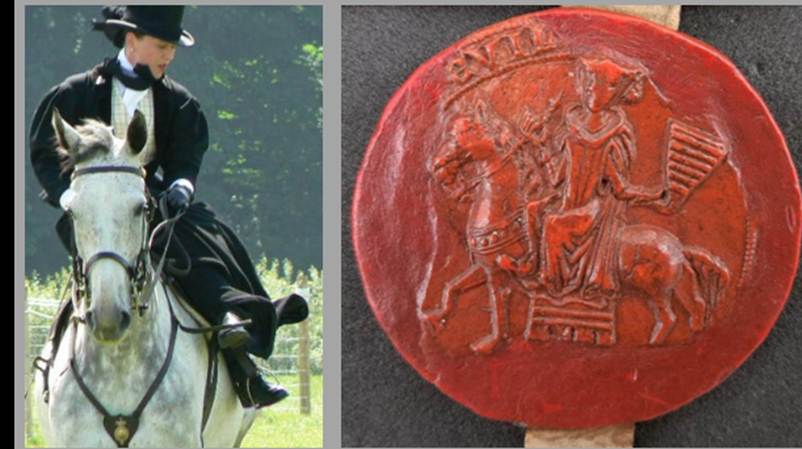
landowners, at the time Joan de Stuteville, the Lady of Liddell. Joan’s seal
bore the image of a lady riding side-saddle, a style which she is reputed to
have been the first to adopt. Perhaps she was occasionally seen riding through
the dale in that fashion. The landlord would have collected a hefty rent from
the tenants and millers of the water mills. We know that Joan was collecting
eleven marcs per annum from the two water mills in
the mid Twelfth century. A marc was two thirds of a pound, or 13s 4d.
By the mid thirteenth century, Farndale was a thriving community
with two watermills. It is likely that the principal watermill was
at modern Low Mill, with another probably smaller mill, a little upstream, at
High Mill.
It seems likely that the mill at Low Mill was first operated by
Simon’s family (FAR00021), in the very
early days as the dale was being cleared for agriculture.
Perhaps John’s family moved into the dale from perhaps the ancient
agricultural lands around Kirkdale, to clear the dale, and John might have eventually
started working as the second miller of Farndale, a little further up the River
Dove.
There is an undated Yorkshire Deed
from about the mid thirteenth century: Grant by Nicholas Devias,
being in good health and lawful power (in mea bona
sanitate et ligia potestafe)
to Alice his wife, for life, of an annual rent of 10 li, which lady Joan de Stotevile gave him for his service, namely, 20s. from the
land in Farndale, held of him by Adam de Ellerschae,
and eleven marcs from his two water-mills in Famedale, and two and a half marcs
from his water-mill in Brauncedale, payable
half-yearly at Michaelmas and Easter. Paying yearly at Christmas one silver
penny for all service, etc. Witnesses, Sir Richard Foliot, Sir Adam Newmarch [de Novo mercato), Sir
Henry Biset, Sir Thomas de Hetun, William de Pligt Peter de Giptun, Clement de
Nortun, Robert de Slucropt,
Colin de Nortun and many others.
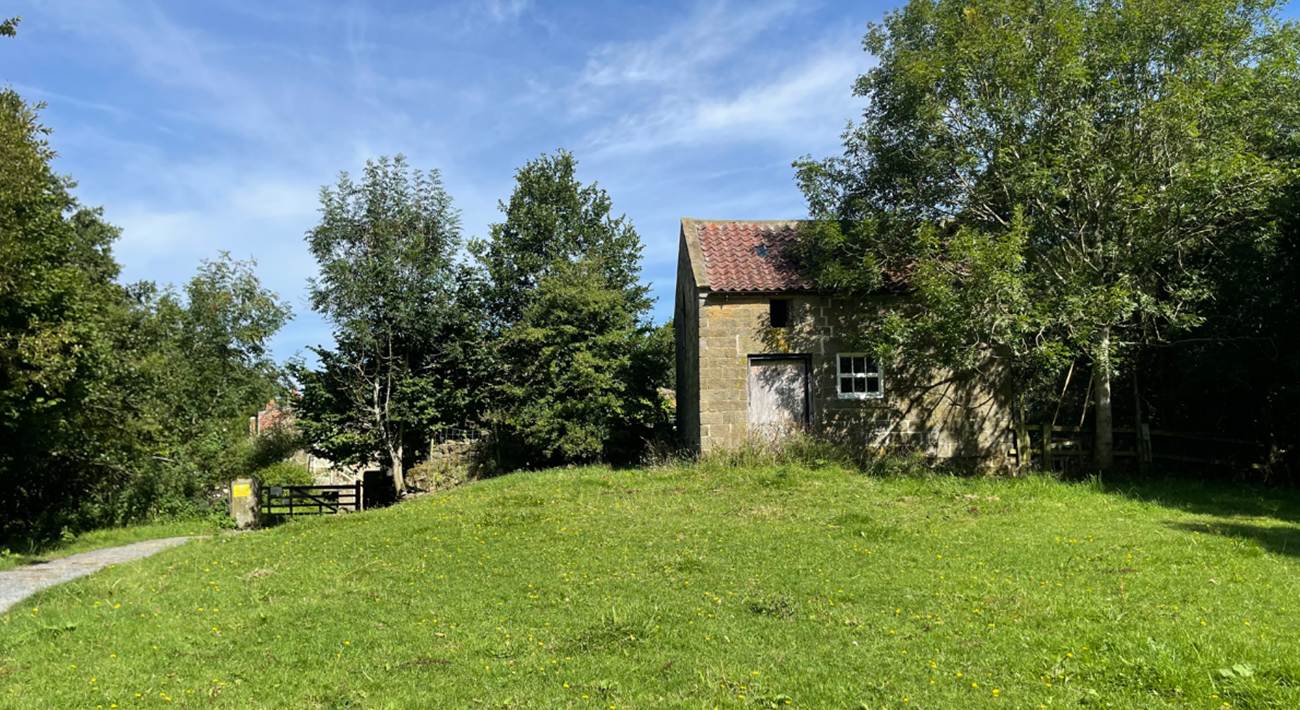
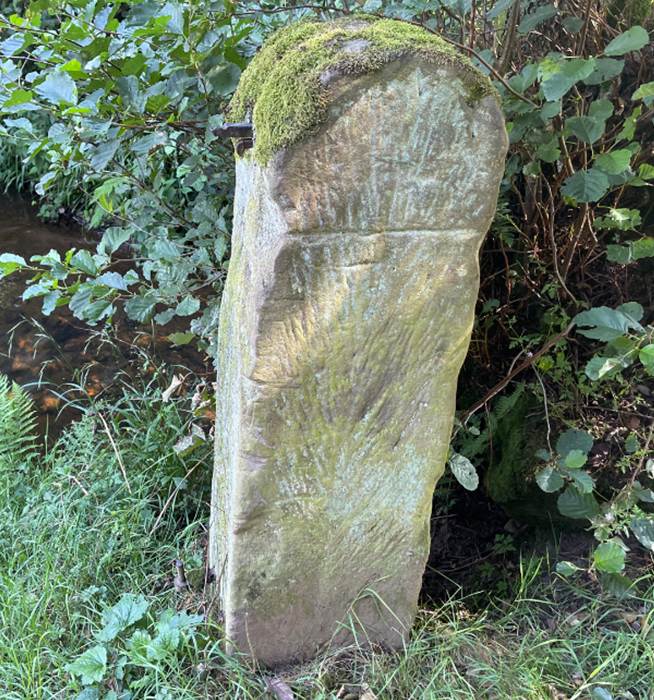
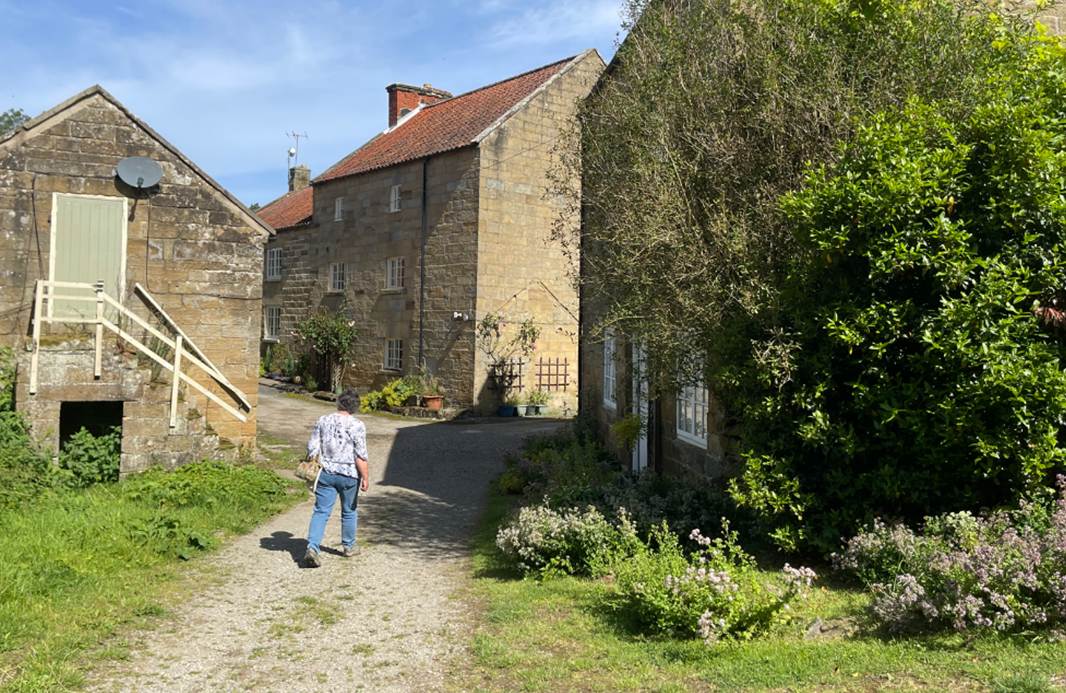
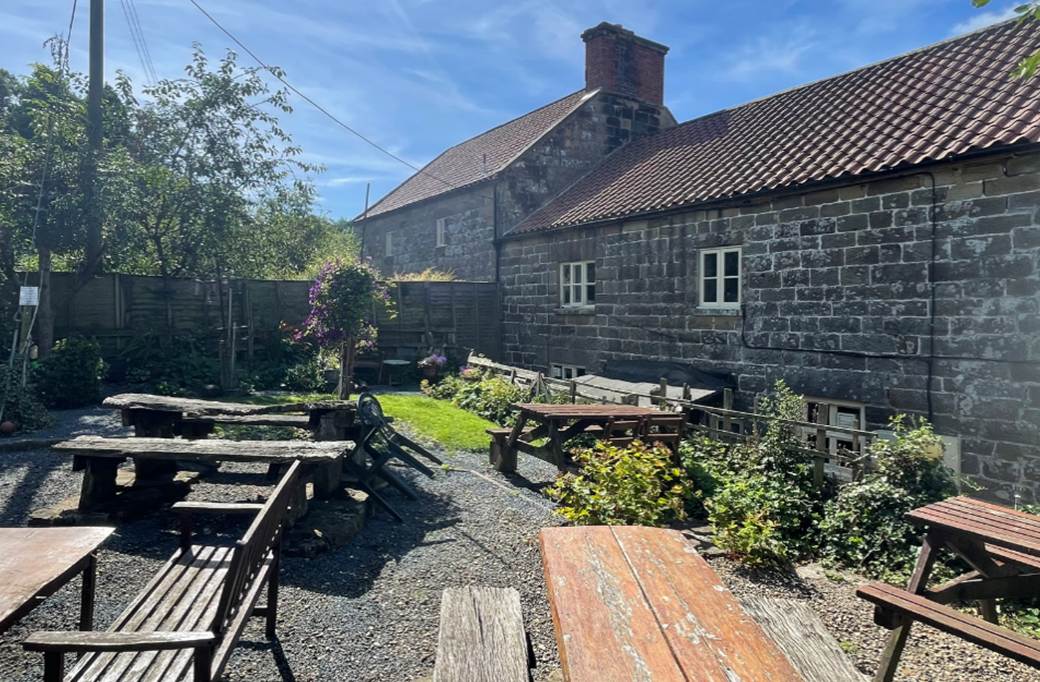
The location of the now disused High
Mill, now known better for the Daffy Café. Perhaps this was once John the
Miller’s place of work.
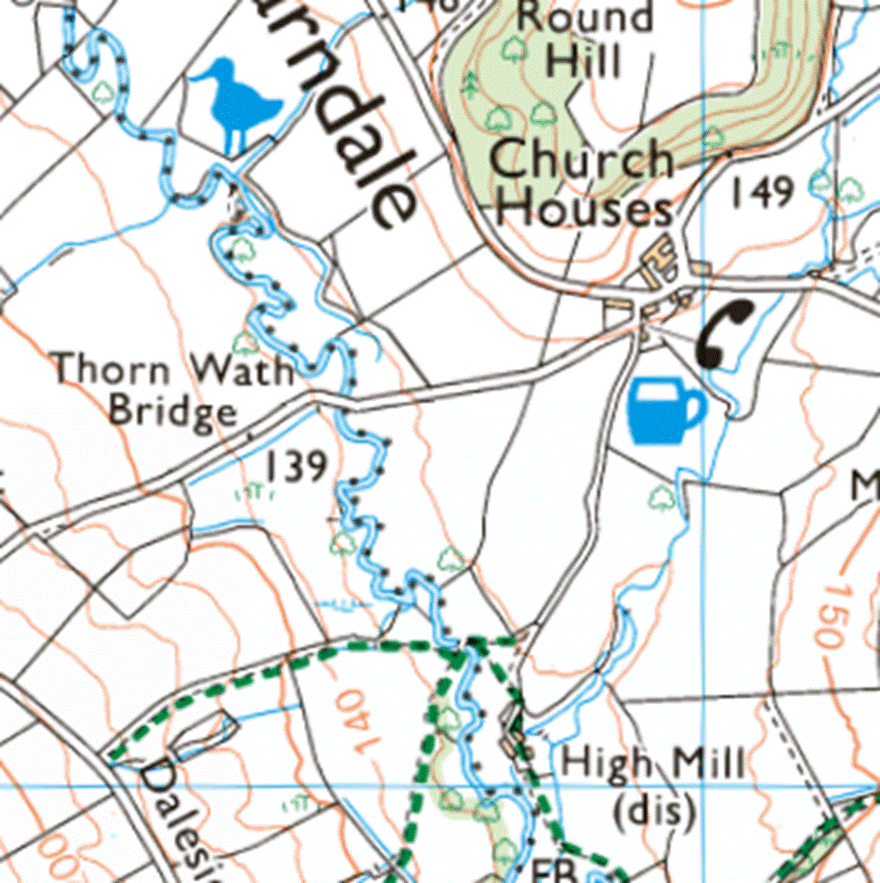
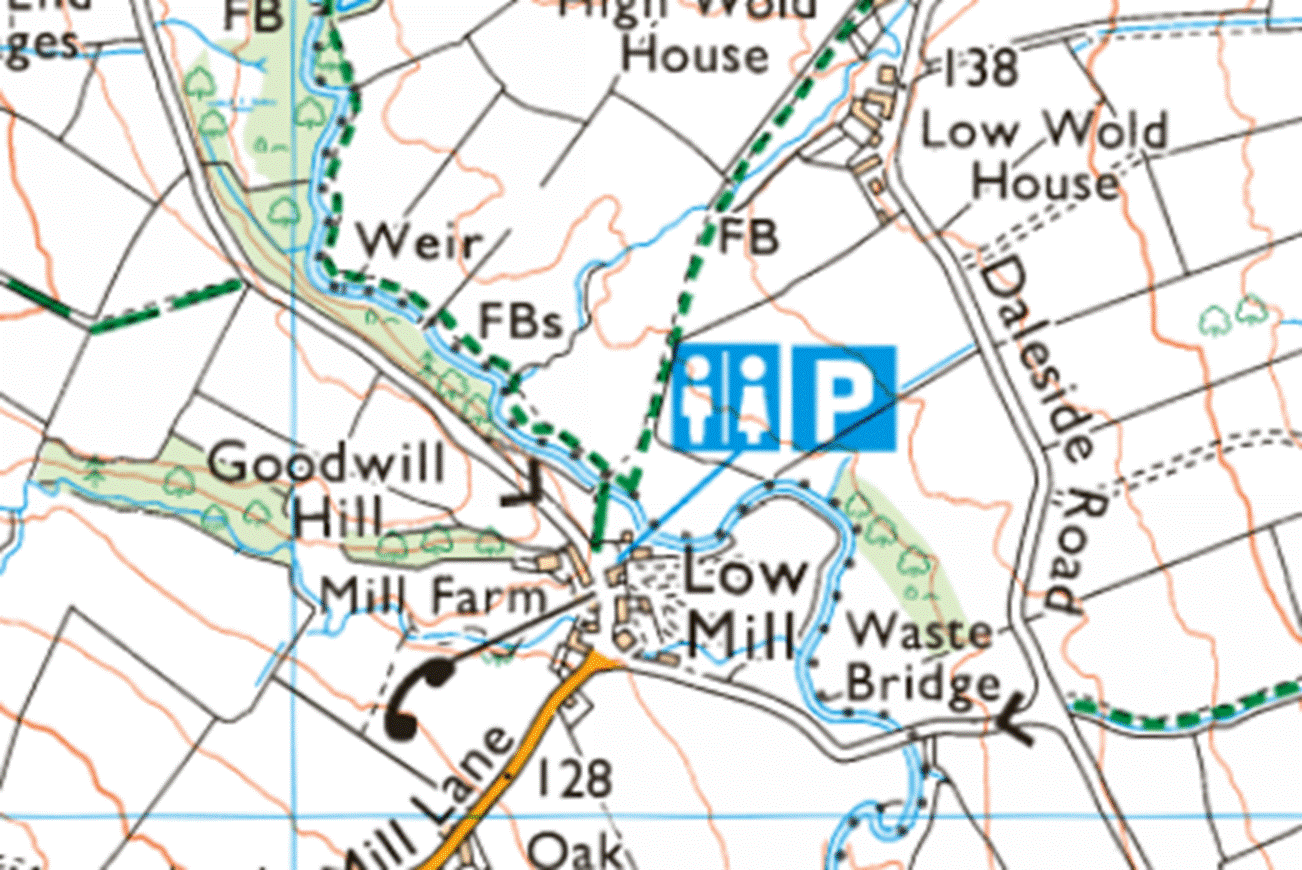
The River Dove would have provided an
optimal source of power for milling. There was a nineteenth century watermill at High Mill on Mill Lane south of Church Houses, Farndale, which is almost certainly the site
of an earlier mill. The hamlet of Low Mill was also the site of an earlier mill
on the River Dove and is located where the fast flowing West Gill Beck flows
down from the high ground to meet the River Dove. Both these mills were located
centrally within the valley. There are also remains of a watermill at Low Elm House in neighbouring Bransdale.
|
Medieval
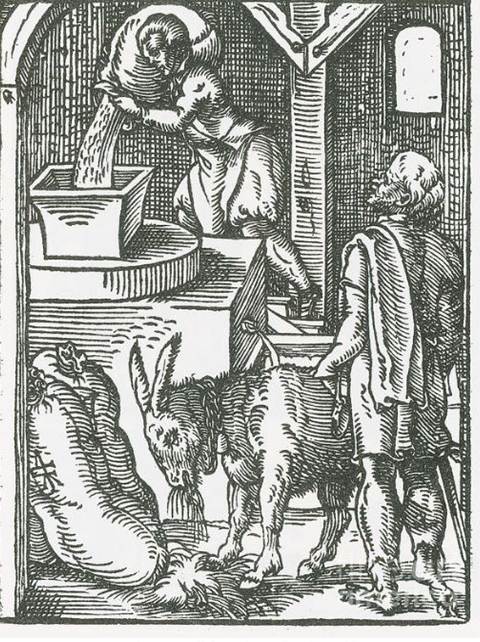
milling and the mills of Farndale. |
c 1256
There is no record of John’s birth or of his early life. We first
hear of John in 1323 as the father of Richard, who had been caught poaching. In
1300, Richard, if the same person, had a gift of land. We might therefore
suspect that Richard was born in say 1275, so that John may have been born in
say 1256.
c 1275
We cannot know when or who Simon married. Given the likely dates
of the births of his children, it seems possible that he would have married in about 1275,
when he might have been about 19.
His perhaps eldest son, Richard de Farndale (FAR00016), might have been born that year.
1276
By 1276, at the time of the death of Joan Stuteville, about 545
acres of Farndale was under cultivation (see FAR00017). The bonded
tenants paid a standard rent of 1s per acre. By that time there were seven
cottars in Farndale and further occupation at Duthenwayt,
probably in the area of the Duffin Stone today, up the western side of the
dale. John was likely to have been part of a community of villeins,
tilling the land, and paying high rents to the Stuteville landowners.
*
*
On 9 July 1288 Adam (FAR00025), son of Simon
the miller of Farndale (FAR00021), and Richard (FAR00016), son of John the miller (FAR00021B), with
three other unknown men, came into Pickering Forest in a place called Petroneldel, and took two deer. When they had been
proclaimed by the forester, they sent away one deer, which the foresters
carried to the castle of Pickering, but the wrongdoers carried away the other
deer with them and thereupon did their will. They do not come to a hearing on 3
October 1334 and the sheriff was ordered to apprehend them. Later, Adam and
Richard came before the justices and asked to pay for licence to make concord
for their offence so that they could be redeemed. Adam paid 26s 8d and Richard
paid 40s for this licence, and they found mainpernors
(or guarantors) for these amounts (The Great Cowcher of the Duchy of Lancaster, The
National Archives, DL42/1 Folio 217, DL 42/1/23/U22 folios 217 to 218v).
Under the Pleas of the Forest there was a
hearing on the Monday next after Michaelmas 8 Edw. III (1334 to 1335).
Michaelmas is 29 September each year. The next Monday in 1334 was 3 October
1334.
Adam, son of Simon the miller of Farndale,
and Richard, son of John the miller were the alleged offenders.
It is presented that they and three unknown
men, on Friday next after the feast of the Translation of St Thomas 17 Edw. I
(1288 to 1289), came in the said forest in a place called Petroneldel,
and there took two deer. And when they had been proclaimed by the forester,
they sent away one deer, which the foresters carried to the castle of Pikeryng [Pickering], and another deer the wrongdoers
carried away with them and thereupon did their will. They do not now come, but
it is witnessed that they are staying in the country. Therefore the sheriff is
ordered to make them come.
The Feast of the Translation of St. Thomas
refers to the celebration of the moving of Thomas Becket's relics from his tomb
in the crypt to a new shrine in Canterbury Cathedral's Trinity Chapel on 7 July
1220. This event is commemorated annually on July 7th and is distinct from his
martyrdom, which is celebrated on December 29th. The relevant Friday was
therefore 9 July 1288.
Afterwards Adam and Richard came before the
justices and upon this sought licence to make concord, and they are redeemed,
namely Adam at 26s 8d and Richard at 40s. And they found mainpernors,
etc.
In the same hearing Roger Drye, Richard Drye,
John Sumpter, abbot of Whiteby [Whitby], Henry le Parker, Peter de Acclom
[Acklam], Peter, his groom, William de Elredby, John
Paulyn, groom of the said Peter, and Walter le Hunter were alleged on Friday
next before the feast of St Thomas the Apostle in the said year, they came with
bows and arrows and five greyhounds, three of which were of the abbot of Whiteby [Whitby], in the said forest in a certain place
called Yarnolfbek, and they took there one four-year-old
stag (sourum), and they carried it away with them and
did their will thereupon. They do not now come, nor were they previously
attached, but it is witnessed that they are staying in the country. Therefore
the sheriff is ordered to cause them to come.
A hind is a female deer, especially a red deer. The forest offices
gave evidence that they left one of the hinds, but took the other a long way
off. They were to be arrested.
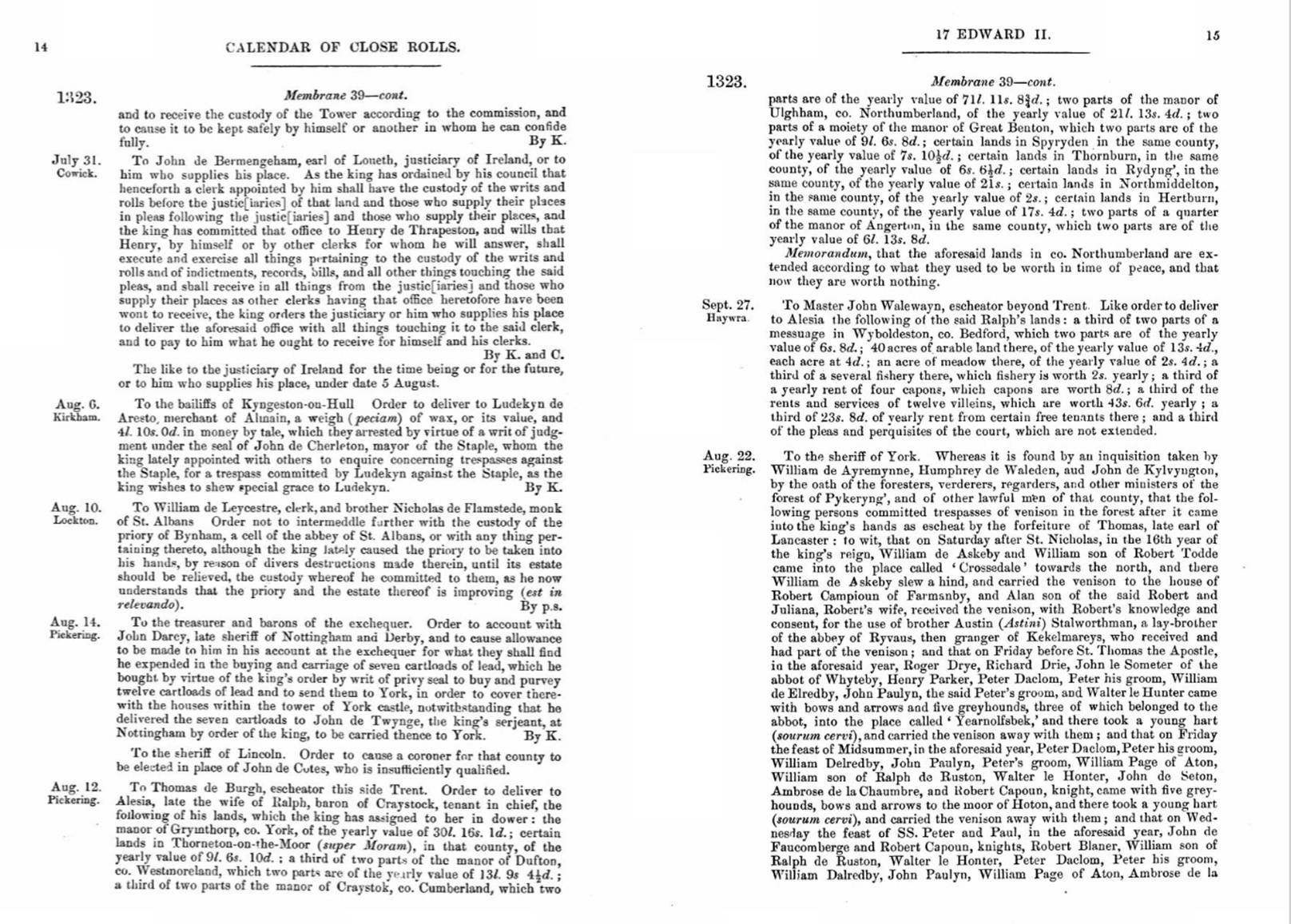
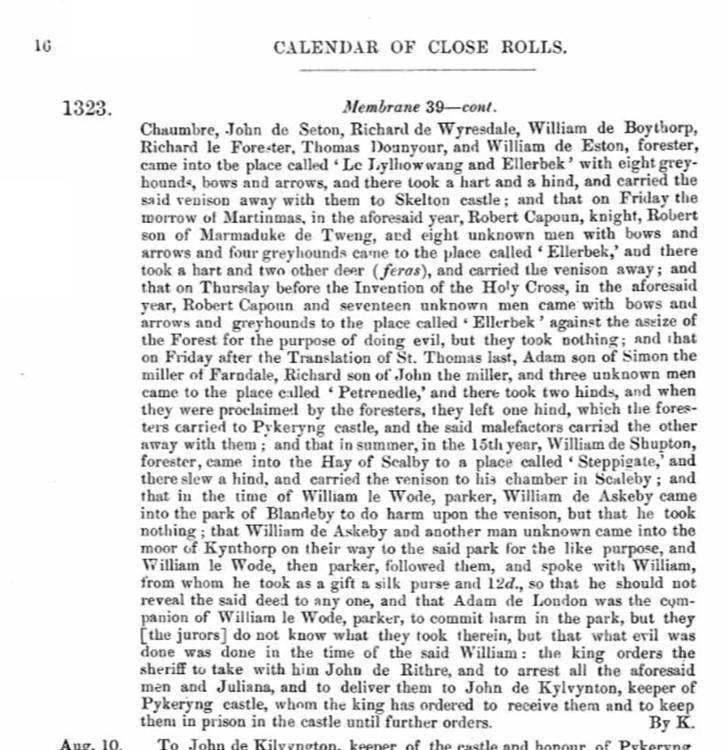
In the Calendar of the Close Rolls, 22
August 1323: Pickering. To the sheriff of York. Whereas it is found
by an inquisition taken by William de Ayremynne,
Humphrey de Waleden, and John de Kylvyngton,
by the oath of the foresters, verderers, regarders, and other ministers at the
forest of Pickering, and of other lawful men of that county, that the following
persons committed trespass of venison in the forest after it came into the
King's hands as escheat by forfeiture of Thomas, late earl of Lancaster... that
on Friday the morrow of Martinmas, in the aforesaid year, Robert Capoun, knight, Robert son of Marmaduke de Tweng, and eight unknown men with bows and arrows and four
greyhounds came to a place called ‘Ellerbek’, and there took a hart and two other deers (feras), and carried the venison away; and that on Thursday
before the Invention of the Holy Cross, in the aforesaid year, Robert Capoun and seventeen unknown men came with bows and arrows
and greyhounds to the place called ‘Ellerbek’ against the assize of the forest
for the purpose of doing evil, but they took nothing; and that on Friday after
the Translation of Saint Thomas last, Adam (FAR00025) son of Simon
the Miller of Farndale, Richard son of John the Miller, and three
unknown men came to a place called ‘Petrenedle’, and
there took two hinds, and when they were proclaimed by the foresters, they left
one hind, which the foresters carried to Pykeryng
castle and the said malefactors carried the other away with them;... the King
orders the sheriff to take with him John de Rithre,
and to arrest all the aforesaid men and Juliana, and to deliver them to John de
Kylvynton, keeper of Pykeryng
castle, whom the king has ordered to receive them and to keep them in prison in
the castle until further orders.
‘At Pickering
before the Sheriff of York in 1323, on Friday after the translation of St
Thomas last, Adam son of Simon the miller of
Farndale, Richard the son of John the miller three unknown men came to
the place ‘Petrenedle’ and there took two hinds and
when they were proclaimed by the foresters they left one hind which the
foresters carried the other way with them...(long list of other
offenders)...... The King orders the Sheriff to take with him John de Rithre and to arrest the aforesaid men and deliver them to
John de Kyltynton, Keeper of Pyckeryng
Castle whom
the King ordered to receive them and to keep them in prison until further
orders.’ (Close Rolls 22 August 1323, 17 Edward II page 15 and 16, North Riding Records Yorks, The Honour and Forest of
Pickering, 1894, Volume II at page 217 to 218).


1323
Adam (FAR00025) son of Simon Miller of Farndale (FAR00021), Richard (FAR00016) son of John Miller (FAR00021B), and three persons unknown, on Friday, 1
July, 1323, took two hinds in Parnelldale, and when
they were proclaimed by the foresters they gave up one hind, which the foresters
carried to Pickering Castle, but the poachers carried away the other. Adam
fined £1 6s 8d, Richard £2.
(North Riding Records Yorks, The Honour and Forest of
Pickering, 1894, Volume II at page 96).
3 October 1334
An eyre hearing picking up cases from 1288 to
1334 took place at Pickering. There is a suggestion that the date of this first
sitting was 6 October 1334, but this seems wrong (The Duchy of
Lancaster Records, from the North Riding Record Society, The Honour and
Forest of Pickering, Edited by Robert Bell Turton, Volume IV, 1897, page
xiii).
At the hearing on 3 October 1334,
after Richard (FAR00016), son of John the miller of Farndale (FAR00021B) and Adam (FAR00025),
son of Simon the miller of Farndale (FAR00021) had trespassed and hunted in Pickering
Forest, others including Adam (FAR00022A),
son of Nicholas de Farndale
(FAR00006), and John (FAR00016A), son of John the miller (FAR00021B) and John Wraghby of Farndale (WRA00001) mainperned (provided guarantees) for their
appearance (The Great Cowcher of the Duchy
of Lancaster, The National Archives, DL42/1 Folio 227, 227v, DL 42/1/35/U7 folios 337 to 338v).
Regarding Trespassers of the hunt and their mainpernors, who were sent away and do not come, there was
a hearing on the Monday next after Michaelmas 8 Edw. III (1334 to 1335).
Michaelmas is 29 September each year. The next Monday in 1334 was 3 October
1334.
Richard, son of John the miller of Farndale,
and Adam, son of Simon the miller of Farndale were the alleged offenders.
It is found by the same rolls (ie the rolls of the verderers of this forest) that,
after they trespassed about hunting in this forest, Richard and Adam were sent
away by the mainprise of Nicholas de Repynghale [Rippingale], Adam, son of Nicholas de Farndale, Nicholas Laverok, John, son of John the miller, Nicholas de Brakenthwayt [Brackenthwaite[,
Alan de Wraghby [Wragby] and John Wraghby
of Farndale, who mainperned to have them on the first
day of the eyre, and they so not now have them, etc.
Afterwards the said mainpernors
came and each of them made a fine by himself, as appears in the rolls of estreats, except for Nicholas de Repynghale
[Rippingale], who has died. Therefore nothing further
is to be done about him.
The offence was clearly many years before as
one or more of the mainpernors had died.
On 3 October 1334, as mainpernors
(guarantors)
·
for Richard (FAR00016), son of John de Farndale (FAR00021B), indicted of hunting, Alan (FAR00011), son of Nicholas de Farndale (FAR00006) was fined 40d because Richard did not
turn up.
·
Alan (FAR00011), son of Nicholas de Farndale (FAR00006) was also fined 40d as mainpreneur for the hunting offences of Adam (FAR00025), son of Simon the miller of Farndale (FAR00021).
·
Nicholas
Laverock was fined 20d as mainpernor of John de Farndale (FAR00016A), also indicted for hunting.
·
Nicholas
Laverock was also fined 20d as mainpernor of Adam (FAR00025), son of Simon the miller (FAR00021), also indicted for hunting.
·
John (FAR00016A),
son of John the miller (FAR00021B) was fined 2s as mainpernor
of Richard (FAR00016), son
of John the miller of Farndale (FAR00021B), also indicted for hunting.
·
John (FAR00016A),
son of John the miller (FAR00021B) was also fined 2s as mainpernor of Adam (FAR00025), son of Simon the miller (FAR00021), also indicted for hunting.
·
William le Smyth of Farndale (FAR00037) was fined 2s as mainpernor
of Robert (WES00005), son of Richard de Westgill (WES00001), also indicted for hunting.
·
William le Smyth of Farndale (FAR00037) was also fined 2s as mainpernor of John (WES00004), son of Richard de Westgill (WES00001), also indicted for hunting.
·
Nicholas Brakenthwayt was fined 2s as mainpernor
of Richard (FAR00016), son of John the miller of Farndale (FAR00021B), also indicted for hunting.
·
Nicholas Brakenthwayt was also fined 2s as mainpernor
of Adam (FAR00025), son of Simon the miller (FAR00021), also indicted for hunting.
·
Alan de Braghby was fined 3s as mainpernor
of Richard (FAR00016), son of John the miller of Farndale (FAR00021B), also indicted for hunting.
·
Alan de Braghby was fined 2s as mainpernor
of Adam (FAR00025), son of Simon the miller (FAR00021), also indicted for hunting.
·
John de Braghby was fined 20d as mainpernor
of Richard (FAR00016), son of John the miller of Farndale (FAR00021B), also indicted for hunting.
·
John de Braghby was also fined 20d as mainpernor
of Adam (FAR00025), son of Simon the miller (FAR00021), also indicted for hunting.
(The Great Cowcher of the Duchy
of Lancaster, The National Archives, DL42/1 Folios 336v and 337, DL 42/1/35/U6, Folio 335v-336v
(not on public record)).
Under
medieval forest law, mainpernors were individuals who
acted as guarantors for others, ensuring they appeared in court to answer for alleged
offenses against forest law. These offenses primarily involved the king's
hunting rights and the protection of forest resources like timber and
vegetation. Mainpernors essentially vouched for the
accused's future appearance in court, preventing them from fleeing justice
within the forest jurisdiction.
Richard,
son of John the miller of Farndale, and Adam, son of Simon the miller of
Farndale: After they trespassed about hunting in this forest, Richard and Adam
were sent away by the mainprise of Nicholas de Repynghale
[Rippingale], Adam, son of Nicholas de Farndale,
Nicholas Laverok, John, son of John the miller,
Nicholas de Brakenthwayt [Brackenthwaite[,
Alan de Wraghby [Wragby] and John Wraghby
of Farndale, who mainperned to have them on the first
day of the eyre, and they so not now have them, etc. (The Great Cowcher of the Duchy of Lancaster, The National
Archives, DL 42/1/23/U28 Folios 226v to 228, DL
42/1/35/U9, Folio 341 to 343v).
In respect
of Fines, amercements and issues of forfeitures at Pikeryng
[Pickering] before Richard de Wylughby [Willoughby],
Robert de Hungerford and John de Hambury, itinerant
justices assigned to take the pleas of the forest of Henry, earl of Lancaster,
of Pickering on Monday next after Michaelmas 8 Edw. III (1334 to 1335).
Michaelmas is 29 September each year. The next Monday in 1334 was 3 October
1334.
Alan, son
of Nicholas de Farndale, one of the mainpernors of
Richard, son of John de Farndale, indicted of hunting.
He is fined
40d, because he did not have him, by the pledge of John Alberd.
The same
Alan, son of Nicholas de Farndale, one of the mainpernors
of Adam, son of Simon the miller of Farndale, indicted of hunting.
He is fined
40d, because he did not have him, by the pledge of John Alberd.
Nicholas Laverok, one of the mainpernors
of Richard, son of John de Farndale, indicted of hunting.
He is fined
20d, because he did not have him, by the pledge of Walter de Shaghe.
The same
Nicholas Laverok, one of the mianpernors
of Adam, son of Simon the miller, indicted of hunting.
He is fined
20d, because he did not have him, by the pledge of John, son of Walter de Shaghe.
John, son
of John the miller, one of the mainpernors of
Richard, son of John the miller of Farndale, indicted of hunting.
He is fined
2s, because he did not have him, by the pledge of William le Smyth.
The same
John, son of John the miller, one of the mainpernors
of Adam, son of Simon the miller, indicted of hunting.
He is fined
2s, because he did not have him, by the pledge of William le Smyth.
William le
Smyth of Farndale, one of the mainpernors of Robert,
son of Richard de Westgill, indicted of hunting.
He is fined
2s, because he did not have him, by the pledge of Nicholas de Farndale.
The same
William le Smyth of Farndale, one of the mainpernors
of John, son of Richard de Westgill, indicted of
hunting.
He is fined
2s, because he did not have him, by the pledge of Nicholas de Repyngale [Rippingale].
John, son
of John the miller, one of the mainpernors of
Richard, son of John the miller of Farndale, indicted of hunting.
He is fined
2s, because he did not have him, by the pledge of William le Smyth.
The same
John, son of John the miller, one of the mainpernors
of Adam, son of Simon the miller, indicted of hunting.
He is fined
2s, because he did not have him, by the pledge of William le Smyth.
Nicholas Brakenthwayt, one of the mainpernors
of Richard, son of John the miller of Farndale, indicted of hunting.
He is fined
2s, because he did not have him, by the pledge of Nicholas de Repyngale [Rippingale].
The same
Nicholas Brakenthwayt, one of the mainpernors
of Adam, son of Simon the miller, indicted of hunting.
He is fined
2s, because he did not have him, by the pledge of Nicholas de Repyngale [Rippingale].
Alan de Braghby, one of the mainpernors
of Richard, son of John the miller of Farndale, indicted of hunting.
He is fined
3s, because he did not have him, by the pledge of John de Braghby.
The same
Alan de Braghby, one of the mainpernors
of Adam, son of Simon the miller, indicted of hunting.
He is fined
2s, because he did not have him, by the pledge of John de Braghby.
John de Braghby, one of the mainpernors
of Richard, son of John the miller of Farndale, indicted of hunting.
He is fined
20d, because he did not have him, by the pledge of Alan de Braghby
and Ralph de Cropton.
The same
John de Braghby, one of the mainpernors
of Adam, son of Simon the miller, indicted of hunting.
He is fined
20d, because he did not have him, by the pledge of Alan de Braghby
and Ralph de Cropton.
On 3 October 1334, as mainpernor
(guarantor) Richard (FAR00016), son of John (FAR00021B), and Adam
(FAR00025), son of Simon the miller of Farndale (FAR00021),
Nicholas de Rippingale was fined 5s because
they did not turn up.
(The Great Cowcher of the Duchy of Lancaster, The National
Archives, DL42/1 Folios 342v).
In respect
of Fines, amercements and issues of forfeitures at Pikeryng
[Pickering] before Richard de Wylughby [Willoughby],
Robert de Hungerford and John de Hambury, itinerant
justices assigned to take the pleas of the forest of Henry, earl of Lancaster,
of Pickering on Monday next after Michaelmas 8 Edw. III (1334 to 1335).
Michaelmas is 29 September each year. The next Monday in 1334 was 3 October
1334.
Nicholas de Repyngale
[Rippingale], one of the mainpernors
of Richard, son of John, and Adam, son of Simon the miller of Farndale,
indicted of hunting.
He is fined 5s, because he did not have them,
by the pledge of Walter Trusseleygh.
On 25 January 1335 in Fines, amercements and issues of forfeitures
at Pikeryng before Richard de Wylughby
[Willoughby], Robert de Hungerford and John de Hambury,
itinerant justices assigned to take the pleas of the forest of Henry, earl of
Lancaster, of Pickering, Nicholas de Repyngale [Rippingale], one of the mainpernors
of Richard, son of John, and Adam, son of Simon the miller of Farndale,
indicted of hunting (The Great Cowcher of the Duchy of Lancaster, The National Archives, DL 42/1/35/U9, Folio 341 to 343v).
A number of individuals from Farndale were fined following prior
indictments for poaching in 1334 and not turning up at the Eyre. They paid bail
or had bail paid for them (North Riding Records, Volume IV by the North Yorkshire Record
Society, the Honour and Forest of Pickering, 1897, page 23 and 28, not on line but
I have a physical copy). The text is an extract from the Coucher
Book of the Records of the Duchy of Lancaster.
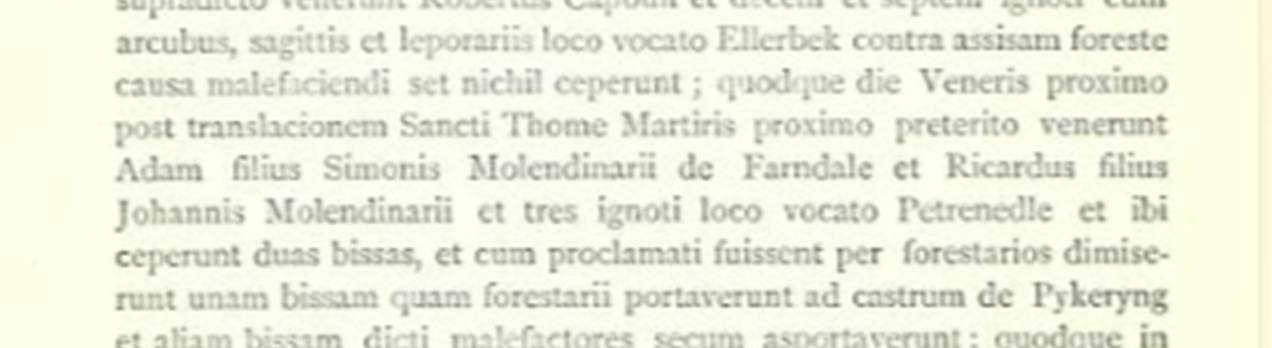
A hearing occurred in [1334) in respect of Fines, amerciamenta et exitus foreste apud Pickering coram Ricardo de Wylughby,
Roberto de Hungerford et Johanne de Hambury Justiciariis at itinerandum ad
placita foreste Henrici Comitis
Lancastrie de Pickering assignatus
die lune proximo post festum sancti michaelis anno regni regis edwardi terchi a conquestu octavo which translates as “Fines,
amercements and exits of the forest at Pickering before Richard de Wylughby, Robert de Hungerford and John de Hambury, Justiciary, at the journey to the forest of Henry
Earl of Lancaster of Pickering, assigned on Monday next after Michaelmas in the
year of the reign of King Edwardi, the third, the
eighth from the conquest.”
This seems to refer to a hearing about events which were dealt
with by Richard de Wylughby, Robert de Hungerford and
John de Hambury in the 1334 eyres, but which had been
recorded at a previous eyre in the eight regnal year of the reign of Edward
III, being 1334 to 1335. Michaelmas is celebrated on 29 September. The following Monday in 1334 was 3 October
1334.
(The Duchy of Lancaster Records, from the North Riding Record
Society, The Honour and Forest of Pickering, Edited by Robert Bell
Turton, 1897, page 23 and 28)
The series of eyres which began in Pickering in 1334 were the
first hearings of the itinerant eyre court for decades and they heard cases
dating back to the 1280s. I have seen an interpretation that the offences
committed by the folk of Farndale, which are listed below, occurred in 1280. I
believe this is an incorrect interpretation of text which might suggest the
eighth regnal year of Edward I, being 1279 to 1280, which I suspect misreads Edwardi as Edward I, instead of Edwardi
terchi or Edward III.
Nevertheless these offences appear about a third of the way amidst
a list stretching over 25 pages of text, amounting to a multiplicity of cases
which is consistent with the fact that the eyre was dealing with cases going
back many decades.
Whilst the text doesn’t explain when the poaching offences
occurred, it might be reasonable to suppose they occurred several years
previously. In the table below I have adopted provisional dates for each
offence in order to provide us with a model upon which to build a chronology.
The relevant text begins De Rogero
Drye uno manucaptorum Ricardi
Drye indictali
de venacione de
fine quia ipsum
non habaerunt primo
die itineris prout eum manucepetunt
per plegium Ade
de Spayne.
The translated text reads From
the following sureties
of persons indicted
for poaching for
not producing the persons
so indicted on
the first day
of the Eyre
in accordance with their
suretyship as to
Richard Drye, from
Roger Drye 2s, bail
Adam de Spayne, [336]
from Hugh Lenonus 1s 8d,
bail Adam de Sartrye from
John White 3s,
bail Adam de Sartrye and
Nicholas Ylle, from
Roger de Verdale
2s, bail Adam
de Sartrye
; as
to William Haye from
Alan son of
Alexander 1s, bail
Roger de Stapelton but
no fine in
respect of his
suretyship for Adam
de Suthfield because he
is poor ; from
Robert son of
Alexander, as to
William Haye and Adam
de Suthfield 1s
each, bail Roger
de Stapelton and 1s
8d as
to Richard father of
William Haye, bail
Adam de Sartrye ; from
Roger de Verdale 1s 8d each
as to William
Haye and his
father Richard,
bail Adam de Sartrye ; from
Roger de Multhorp 2s
each as to
the same persons with
the same bail ;
as to
John son of
Abbas 1s 8d from Roger son
of Gilbert of
Farndale, bail
Nicholas de Repyngale, 2s
from John de Hutton,
bail John Albred,
1s from Thomas
Makaunt,
bail Roger son of
Gilbert, 3s 4d
from Henry Tunge, bail
Nicholas de Repyngale, 2s from
Peter son of
Gervase, bail Elias Cokerell; as to
John Cokerell
2s from Roger
merchant of Pickering,
bail Peter son of
Gervais and 2s
from William Smith
of Crofton, bail
Nicholas de Repyngale
; as
to John son
of Richard de Westgill 3s
4d from Robert Westgyll, bail
Nicholas de Farndale,
[336b] 2s from
John Alberd,
bail William the
Smith, 3s 4d from
John Shepherd of
Farndale, bail Nicholas de Repyngale, 2s from William
the Smith of
Farndale, bail Nicholas de
Farndale ; as to
Robert son of
Richard de Westgill 2s from
John Alberd, bail
William the Smith,
2s from John
son of Walter, bail
John Alberd, 2s
from William the
Smith of Farndale,
bail Nicholas de Repyngale; as
to each of
Richard son of
John and Adam son
of Simon both
millers of Farndale,
3s 4d from Alan
son of Nicholas of
Farndale, bail John Alberd, 1s 8d from
Nicholas Laverok, bail Walter
de Shaghe, 2s
from John son
of John Miller,
bail William the smith (North Riding Records
Yorks, Volume IV, The Honour and Forest of Pickering).
This record relates to claims for sureties or guarantees for
people who had been indicted for poaching. I translate the two types of
formulae in this text as:
· as to [Guarantor]
1s 8d from [Poacher],
bail [payer]; or
· 2s
from [Poacher],
bail
[Guarantor and payer].
These
formulae may need some further consideration since, on this approach,
individuals appear as both poachers and guarantors and the same individual
appears as a payer for an absent poacher and an
absent poacher at the same hearing. It is though possible that in an age of
rough justice, the indigenous population were rounded up and treated in an
arbitrary manner.
Therefore a summary of those individuals from Farndale is as
follows:
|
Date of Hearing |
Notional date of Offence |
Payer |
Guarantor (malpernor) |
Poacher |
Amount of Fine |
|
3 October 1334 |
c 1315 |
Nicholas de Repyngale |
John son of
Abbas (ADA00003) |
1s 8d |
|
|
3 October 1334 |
c 1315 |
John Albred |
John de Hutton (HOT00003) |
John de Hutton (HOT00003) |
2s |
|
3 October 1334 |
c 1316 |
Roger son of Gilbert
of Farndale (FAR00013A) |
Thomas Makaunt |
Thomas Makaunt |
1s |
|
3 October 1334 |
c 1317 |
Elias Cokerell (COK00002) |
Peter son of
Gervase |
Peter son of
Gervase |
2s |
|
3 October 1334 |
c 1317 |
Peter son of Gervais
|
John Cokerell (COK00001) |
Roger merchant of
Pickering |
2s |
|
3 October 1334 |
c 1319 |
Nicholas de Farndale (FAR00041A) |
John son of
Richard de Westgill (WES00004 ) |
Robert Westgyll (WES00005) |
3s 4d |
|
3 October 1334 |
c 1319 |
Nicholas de Repyngale |
John Shepherd of
Farndale (FAR00010) |
John Shepherd of
Farndale (FAR00010) |
3s 4d |
|
3 October 1334 |
c 1319 |
Nicholas de Farndale (FAR00041A) |
William the Smith
of Farndale (FAR00037) |
William the Smith
of Farndale (FAR00037) |
2s |
|
3 October 1334 |
c 1319 |
William the Smith (FAR00037) |
Robert son of
Richard de Westgill (WES00005) |
John Alberd |
2s |
|
3 October 1334 |
c 1320 |
John Alberd |
2s |
||
|
3 October 1334 |
c 1320 |
Nicholas de Repyngale |
William the Smith
of Farndale (FAR00037) |
William the Smith
of Farndale (FAR00037) |
2s |
|
3 October 1334 |
c 1320 |
John Alberd |
Richard (FAR00016) son of John the Miller of
Farndale (FAR00021B) |
3s 4d |
|
|
3 October 1334 |
c 1321 |
John Alberd |
Adam (FAR00025) son of Simon the
Miller of Farndale (FAR00021) |
3s 4d |
|
|
3 October 1334 |
c 1321 |
William the Smith (FAR00037) |
2s |
In a separate record of further fines for sureties (The Duchy of Lancaster Records,
from the North Riding Record Society, The Honour and Forest of Pickering,
Edited by Robert Bell Turton, 1897, page 34):
|
Date of Hearing |
Notional date of Offence |
Payer |
Guarantor (malpernor) |
Poacher |
Amount of Fine |
|
3 October 1334 |
c 1325 |
Walter Trusseleygh |
Adam (FAR00025) son of Simon the
Miller of Farndale (FAR00021) |
Nicholas de Repyngale |
5s |
Offences committed since the
commencement of the Eyre.
Names of those who had been
arrested for poaching in the forest and had been let out on bail to appear at
the next assizes, but neither appeared nor excused themselves, as the custom
is, together with the names of the bail:
such names are those of offenders,
only it has not been thought necessary to set out the names of the bail, who
varied in number from eighteen to three. The names are William the son of
William Jurour, Thomas Colomb, Robert Porcion, John Chaplain of Hackness,
John Daniel, Adam son of Adam Soullfield, Roger
J)rye, Richard Drye, John Woodward of Brompton, John Cliff, Richard Wyther,
Richard Haye of Hackness, Thomas son of Robert Smith
of Newton, John Motte, William Haye of Hackness,
William Rome, John Seaton, Peter son of Henry Tong of Rosedale, Richard (FAR00016) son of John Miller of Farndale (FAR00021B), and Adam (FAR00025) son of Simon Miller of Farndale (FAR00021), John Brown, Walter Smyth of Hackness,
John son of Simon del Hull of Lockton, John Storm of Levisham,
William son of Moyson of Dales, William Moor senior
of Uglebardby, John
Cockerell of Cropton (COK00001), John Tendbarn of Harewood,
Geoffrey Langdale, Peter Wyles, Thomas Blount of Alverstan,
John (WES00004) son of Richard Westgill of
Farndale (WES00001), Robert (WES00005) son of Richard Westgill of
Farndale (WES00001).
(The Great Cowcher of
the Duchy of Lancaster, The National Archives, DL42/1 Folio 204v, DL 42/1/23/U14 folios 203 to 205 and North Riding Records Yorks
Volume II, The Honour and Forest of Pickering, page
119).
*
*