

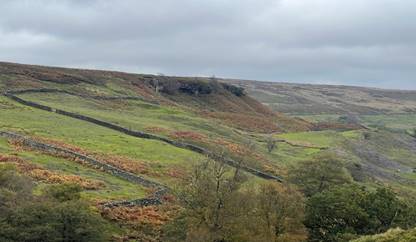
1 - The Family Cradle
In 1154,
Gundreda, on behalf of her son, the young Roger de Mowbray, lord of the lands of
Kirkbymoorside, gave land in perpetual alms to the
brothers of Rievaulx Abbey. The lands included Midelhovet where Edmund the Hermit used to
dwell and another meadow known as Duvanesthuat, lands in the valley of
Farndale. The grant included the use of forest wood. These lands, though part
of the Kirkbymoorside estate, were at its periphery. They were largely forested
lands, part of a vast noble possession, used only rarely for hunting. They were
the place where Edmund the Hermit used to roam, at Midelhovet, a holy
man who performed miracles, who some said was descended from Alfred the Great. This
was the first time the name Farndale had been used, and the name first appeared
in the Chartulary of Rievaulx Abbey.
The people
who lived in the Kirkbymoorside estate had not yet reached the forested inner
dales. They lived in the small town of Kirkbymoorside, or farmed in the
cultivated land around the church of Kirkdale. These folk, of Anglo Scandinavian
descent, farming only a few miles south of Farndale, were the ancestors of a
small group of villeins who would soon clear land in Farndale, and start
cultivation there too. In 1154 those inhabitants of the Kirkdale
lands would have wondered at
the Elven halls of the Cistercians of Rievaulx
Abbey, which had risen from the soil on a vast scale in a nearby valley in
only twenty years since the Cistercian monks had first arrived there. This was
a Lord of the Rings world of strange lands of Midelhovet and Duvanesthuat,
dimly known to the folk of the shires around Kirkdale, where strange monks had so recently
arrived, bringing French Cistercian traditions and constructing wondrous towering
halls.
By 1166
Roger de Mowbray had fallen out of favour with the English King, Henry II, and the lands
of Kirkbymoorside had passed to the House Stuteville.
In the Game of Thrones between barons across the chess board of England,
the folk of the Kirbymoorside estate had fallen under the authority of the House
Stuteville. Robert de Stuteville and granted rights to timber and wood in
Farndale to the Cistercian nunnery at Keldholme, close to Kirkbymoorside town.
In 1209 the Abbot of the Benedictine Abbey of St Mary’s in York obtained rights
in the forest of Farndale from King John. By 1225 there was reference to pastures
in Farndale.
In 1229
Henry III decreed that ‘the whole of the forest of Galtres and the
forest between the Ouse and the Derwent, and the forest of Farndale, are
ancient forests’ and that the people were deceived in exercising their
rights of perambulation of the forest, and the forest should be guarded. The
forest of Farndale had become part of the royal forests, reserved for the King.
In 1233, the Abbot of St Mary’s came to an agreement with the Stuteville family granting
free passage through the wood and pasture of Farndale. There was a
reference to the Botine Wood and the Swinesheved, which suggests
that cattle and pigs were being grazed there. In that same year, Nicholas de Stuteville died, and the estate passed to
his daughter Joan, the wife of Hugh Wake, who was known as the Lady of Lidell.
By 1241, her first husband was dead and she married Hugh le Bigod. In
1253, The King committed to Hugh le Bigod the whole forest of Farnedala,
which the king had lately recovered by consideration of the court against the
abbot of St. Marie Ebor, to be kept until the return of the King from Vasconi,
or as long as it pleased the king. This was confirmed in 1255, for a
payment of 500 marks.
It seems
therefore that the estate of Kirkbymoorside fell under the noble ownership of
the Stuteville family and Joan and through
husbands Hugh Wake and Hugh le Bigod held the primary interest in the cradle of
the Farndale family by 1233. The King withheld the forests, including the
Farndale forests, from 1229 as royal hunting grounds, but by 1253 the Farndale
forests passed back into Stuteville hands for payment of a significant sum of
money. Since 1154 the Cistercians had interests in Farndale and may have used it
first to supply wood to their monastic empires, but might also have used
meadows as pasture for the sheep which would give them their wealth. By the
beginning of the thirteenth century, there is evidence that pigs and cows were
grazed there. In the early thirteenth century the lands of Farndale, which had
been the peripheral lands where hermits used to dwell, were being cleared for
agriculture, a process known as assarting.
The dale in
the early thirteenth century must have been a place of intense activity. Large acreages
of forest were assarted and the plough teams followed, to turn the soil and
begin cultivation. The people who did this work, were the villeins of Anglo-Saxon-Scandinvian
origin, under the Norman Yoke
for some two centuries, vastly experienced agriculturists, whose own ancestors
had cultivated these lands since the Roman estates over a thousand years before
them. The odds were stacked firmly in favour of their noble overlords, who had
held the estate since the Norman Conquest, arbitrarily distributed by the
Conqueror to his supporters and battle heroes. Until now the forested lands of
the dales had been little more than prestige holdings, where they sometimes hunted,
and otherwise used as premiums for their insurance deals with the Cistercian
and Benedictine monks, to ensure their continued good fortune after they died.
As the new thirteenth century dawned however, they had come up with a new idea
to make their otherwise useless holdings profitable. If they encouraged or
bullied the villeins classes who lived in their estates to clear the forest for
agriculture, they could impose obligations in rent and service on those same
folk, thereby deriving a perpetual income.
It is difficult
to know the extent to which the agriculturalists of Kirkdale
and Kirkbymoorside were coerced
or saw opportunity. It was this band of folk, placed into Farndale in the early
thirteenth century, who were the direct ancestors of the modern Farndale
family.
Joan died in
1276, and an Inquisition
Post Mortem (“IPM”) recorded her landholdings as they passed to her
son, Baldwin Wake. IPMs were held when people
died for the benefit of the monarchy, to identify the income and rights due to
the Crown. The record gives us direct evidence of a farming community within
Farndale on a significant scale, paying a standard rent of 1s (12d) for each
acre, providing a combined rent of £27 5s 0d, suggesting some 545 acres in production.
In 1280, we
are introduced to the first individuals
who adopted their new home to themselves as individuals when a group of lads
found themselves in trouble for poaching offences including Roger
son of Gilbert
of Farndale; William
the Smith of Farndale; John
the Shepherd of Farndale, and Alan,
son of Nicholas
de Farndale. In 1293, Robert,
son of Peter
de Farndale was fined at Pickering
Castle for poaching. Also in 1293 Roger
milne (or ‘miller’) of Farndale, another son of Peter, was fined after he
killed a soar and slew a hart with bows and arrows. It seems likely that the
three Dads, Gilbert, Nicholas and Peter, would have been born about the 1230s,
just as the process of land clearance was building momentum. Indeed so many of
our distant ancestors were poachers in Pickering Forest, that the earliest
class of our family might be defined as the Farndale Poachers,
and we’ll explore them some more in another chapter. The first individuals who
introduce themselves to us in the records seem to have been hard working
agricultural folk, pioneers of new lands at the edge of the North York Moors,
whose sons enjoyed the adventure of illegal expeditions in the royal forests.
Joan’s son,
Baldwin Wake died only six years later when another
IPM was held. The Farndale rents now amounted £38 8s 8d together with a nut
rent and a few boon works. Astinishly, assuming the same rent applied, the cultivated
acreage therefore had increased to 768 acres in only six years. This was
organised and planned agricultural development, led no doubt by Joan Wake of
Stuteville descent, but a process in which our ancestors seem to have been
engaged throughout the thirteenth century.
In 1301 a subsidy
was imposed across Yorkshire to help Edward I pay for his wars with Scotland. A
detailed assessment was held in Farndale, which listed the 35 tenants required
to meet the subsidy demand. They included individuals defined by places within
Farndale that are still there today. De Willelmo Wakelevedy was William of Wake
Lady Green on the east dale road. De Radulpho de Westgille was Radolf of the West
Gill stream that runs into modern Low Mill. De Willelmo de Monkegate was William of Monket Gate, now
Monket House at the entrance to the west dale road. De Waltero de Ellerscaye was Walter
of the lands which are now Eller House on the west dale road. These were
settled tenants of sufficient wealth to be stung for taxes to pay for the Scottish
wars. By 1301 there were no individuals defining themselves by the Farndale
name left in Farndale itself. The inhabitants of the dale were more settled,
and they could not use the name of the dale for surnames since they were all
folk of the dale. Logically those who use de Farndale to define themselves were
those pioneers who left Farndale at the end of the thirteenth century and
settled in other places. In those other places, by calling themselves de Farndale,
they gave themselves a uniqueness to
serve as an identity. It is tempting though to deduce that Nicholas
de Farndale, the bailer of his son in 1280, might have been De Nicholao de
Ellrischaye by 1301, who paid 4s 7d in subsidy, by then as an established
member of Farndale society defining himself more precisely than just a person
of the dale which was just a description that he shared with his whole
community.
We know that
by 1301 the individuals who actually used the Farndale name were the pioneers
who had left Farndale, because in the same subsidy of 1301, we find two
individuals living outside Farndale, who called themselves de Farndale. De
Willelmo de Farndale had moved to Danby in the heart of the North York
Moors in the Wapentake of Langburgh, where he paid a significant rent of 3s. He
appears to have been a tenant of relative wealth. De
Johanne de Farndale had moved to Egton,
on the north side of the moors, at the boundary of modern Cleveland, where he
paid another significant rent of 22d. Perhaps they were brothers who had left
the dale to farm in new places.
In 1323,
another wayward son, Adam,
the son of Simon
the Miller of Farndale, took two hinds in Pickering
Forest and was delivered to the Keeper of Pickering
Castle to be imprisoned. In 1332, Simon’s son Robert
was fined at Pickering. In the
1301 subsidy, De Simone Molendinario paid the highest subsidy of 7s and 9d
for the King’s Scottish Wars. Molendinum is Latin for Mill. So Simon
seems to have been the miller of Farndale who by 1301 was perhaps the wealthiest
of the Stuteville tenants. He had two sons, Adam
and Robert,
and may have had others.
An
Inquisition in 1350 referred to an early fair
held in Farndale.
The Close Rolls in 1361 recorded the transfer of
lands, including Farndale, from Thomas Holland, Earl of Kent to his widow
Joan, Countess of Kent, descendant of the Stutevilles. Joan, the Fair Maid of
Kent, who passed down her new side-saddle style of female equestrians, married
Edward, the Black Prince on 10 October 1361. The Black Prince, son of Edward
III, who earned his spurs at the Battle of Crecy, and Joan of Stuteville descent
and landholder of the Farndales lands, would beget Richard II, last of the Plantagenet line.
In 1388
licence was granted to allow the inhabitants of Farndale to celebrate mass
in the chapel there.
We cannot
know the precise relationships in this age when surnames were only starting to
be used to define families in a modern sense. All we can do is to build a
plausible model which might fit the evidence of which we know. It appears that
the earliest members of our family who took the Farndale name were the settled
inhabitants of Farndale itself; the restless sons who poached in the royal forests;
and the pioneers who left Farndale not so long after its early cultivation, to
settle in new places. This might be what the family looked like (with possible
dates):
|
|
|
|
|
|
The Farmers
of the lands around Kirkdale of Anglo-Saxon-Scandinavian
descent
|
|
|
|
|
|
|
|||
|
|
1230 to 1310 Bailer of
his son Alan in 1280
|
|
|
|
|
|
|
|
Alfred
de Farndale
|
1240 to
1310 Paid taxes
in the Eyre Court in 1280 |
1242 to
1315 Paid taxes
in the Eyre Court in 1280 |
|||
|
1263 to
1330 A poacher
in Pickering Forest in 1280 |
1264 to 1335 The Miller
of Farndale The
wealthiest tenant in Farndale in 1301
|
1265 to
1335 Tenant in Danby
in 1301 |
1270 to
1327
|
1273 to
1345
|
1275 to
1345 Had a gift
of land in Martin in 1300 Excommunicated
for poaching and contempt of the authority of the church in 1316 |
1276 to
1345 Excommunicated
for poaching and contempt of the authority of the church in 1316 |
1280 to
1350 Gave bail
for Roger, son of Gilbert Farndale in 1334 |
1255 to 1340 A poacher
in Pickering Forest in 1280 (with his
cousin, Alan?) and a miller and poacher in 1335 |
Roger
Milne (Miller) of Farndale 1260 to
1335 Slew a
soar in Pickering Forest in 1293 |
1265 to
1340 Fined for
poaching in Pickering Forest in 1293
and 1332 |
Roger
de Farndale 1255 to
1340 |
|||
|
1295 to
1370
|
1302 to
1352 An appeal
against him for the death of John de Maunby in 1320 Poacher in
Pickering in 1323 |
1307 to
1377 Poacher in
Pickering in 1332 and 1335
|
1300 to
1370 Vicar of
Haltwhistle, Lazonby, Illisahaghe hospital, Upmeadon, Chelmsford |
1303 to
1372 Excommunicated
for poaching in 1324 Paid taxes
in Crofton de Artoft in 1327 and 1333 (possibly Crofton near Pontefract)
Saddler
and freeman of York in 1363 |
Richard
Farndale Richard
son of John (to be added as individual) was indicted for hunting
in 1334 and 1335 |
|
|
|
|
|
|
|||
|
John
Farndale 1330 to 1400
|
|
1332 To
1397 A Chaplain
of Derleye in 1310 William
Farndale of Caleys was pardoned for the death of John de Spaldyngton (south
of York) in 1370 |
|
1330 to
1415 Vicar of
the Parish of Doncaster from 1397 to
1403 Landholder
at Loversall |
1332 To
1400 Paid the
1379 Poll Tax in Doncaster and married
Alicia
|
|
|
1334 to
1405
|
|
|
|
|||
|
1365 to
1450 Involved
in a significant cattle and horse rustling expedition in 1384 and in trouble
in Adderbury near Banbury in 1390 and Stillington near Stockton in 1445 |
1357 to 20
December 1435
|
1359 to
1420 |
1361 to
1420 |
1365 to 1440 Sheriff Hutton and Gowthorpe |
|
1352 To
1412 Archer in
the wars with Scotland in 1383 to 1389
|
1354 to
1414 Man at
Arms with Thomas Mowbray in the wars with Scotland in 1389 |
1356 To
1416 Archer
with Thomas Mowbray in the wars with Scotland in 1389 |
|
|
|
|||
|
1409 to 1480 Witness to
the Wars of the Roses from the lands of the Nevilles and Richard III |
1411 to
1482 Witness to
the Wars of the Roses from the lands of the Nevilles and Richard III |
1413 to
1483 Witness to
the Wars of the Roses from the lands of the Nevilles and Richard III |
|
1425 to
1490 In 1493, his
widow Rose Farndale sued for a tenement, garden and two fields in Doddinghurst,
Brentwood, which she said had been bought by William from John Reignold
|
|
1378? to
1448? Butcher
and freeman of York in 1408 Likely
trader in the Medieval Shambles, the street of butchers |
|
|
|
|
|
|||
|
|
|
|
|
1460 to
1530 Rector at
South Stoke, Sussex in 1500 and presented to the College of the Holy Trinity
in 1508 |
|
1484 to
1554 In Lythe
in 1524 |
|
|
|
|



















These are
all people about whom we have historical documentary evidence. At the time when
surnames became hereditary, these were the
individuals who chose to define themselves, and their descents to follow, as
Farndale. In some cases, the records tell us who were father and son and
daughter. It is not possible to be certain about the precise relationships of
all these individuals to each other. However the genealogy above has used the
available evidence to compile the most probable family tree of these early
ancestors.
It seems to
me to be likely that all the Farndale descendants are a single family who descend
from one family, because in the early sixteenth century all modern Farndales
appear to have lived in Cleveland, north of the moors, and probably descend
from two individuals, Nicholas
and Agnes
Farndale. There is some evidence that suggests that their son William
Farndale who died in Skelton in
Cleveland was the same William Farndale who married Margaret Atkinson in Campsall, just north of Doncaster in 1564. So it seems likely to me
that all modern Farndales descend from the Doncastrians. There are other
possibilities, but all we can do is to build a model for the most probable
ancestry, using the extensive medieval evidence available to us.
It cannot be
in serious doubt that the modern Farndale family are descended from the
thirteenth century agriculturalists, who cleared the land in the place known as
Farndale from about 1200, and were established tenant farmers by the end of
that century.
The story
continues in other chapters. You can return to the
contents page and explore our history in any way you choose.
I suggest
that you first travel backwards in time. Since Farndale was a part of the
estate of Kirkbymoorside, which was centred
in the town of Kirkbymoorside and the agricultural lands around Kirkdale before lands started to be cleared
in the Dales, our family has a unique opportunity to explore its path through
Norman, Scandinavian, Anglo Saxon and Roman times, throughout which time the
estate was a centre of agriculture. I suggest that you therefore take a path
through:
· Chapter 2 – The People of the
Kirkbymoorside (“Chirchebi”) Estate from 1066 to 1200
· Chapter 3 – The Chirchebi Estate in
the Scandinavian Period 793 CE to 1066
· Chapter 4 – The Chirchebi Estate in
the Anglo Saxon Period 580 CE to 793 CE
· Chapter 5 – The Chirchebi lands in
Roman and Pagan times 71 CE to 580 CE
· Chapter 6 – The Iron Age, Bronze Age,
Neolithic, Mesolithic evidence of the people of the immediate vicinity to
Farndale
These
chapters will not just take you on a generic journey through time, but will take
you to precise locations in the lands of our ancestors, and guide you to
objects which can be seen and visited today, which will bring you into direct
contact with your distant ancestors.
You can then
take a journey forwards from thirteenth century Farndale, through substantial
evidence of the Middle Ages, to modern Britain:
· Chapter 7 – The Poachers of Pickering
· Chapter 8 – The Pioneer ancestors
· Chapter 9 – The Merchants of York
· Chapter 10 – The Medieval Soldiers of
Sheriff Hutton (Battles with Richard II, Henry V and the Wars of the Roses)
· The Story of Sheriff Hutton
· Chapter 11 – The Family of William
Farndale, the Fourteenth Century Vicar of Doncaster
· Chapter 12 – Our ancestral Links to
the stories of Robin Hood
Having
reached the modern era, the journey then continues:
· Chapter 13 – The Sixteenth and Seventeenth
Families of Kirkleatham, Skelton, Moorsholm and Liverton
· Chapter 14 – The Whitby Farndales
· The Mariners
· Chapter 15 – The Ampleforth Farndales
· Chapter 16 – The Kilton Farndales
· Chapter 17 – Descendants of [one]
Kilton Family
· Chapter 18 – John Farndale and the
Industrial Revolution
· Chapter 19 – The Leeds, Bradford,
Coatham, Hartlepool and Stockton Farndales
· Chapter 20 – The Southerners
· The Pioneering Spirit
· Chapter 21 – The Australians
· Chapter 22 – The Ontarians
· Chapter 23 – The Newfoundlanders
· Chapter 24 - The Albertans
· Chapter 25 – The Americans
· Chapter 26 – The New Zealanders
· Chapter 27 – the Great Ayton and
Newcastle clans
· Chapter 28 – The Presbyterians
· Chapter 29 – The Ironstone Miners
· Chapter 30 – The Victorian Policemen
(including two Chief Constables)
· Chapter 31 – The Soldiers
· Chapter 31 – The Miners
· Chapter 32 – Tidkinhow
· Chapter 33 – Time Travel
· Chapter 34 - Genealogy