Cloverley
A
history of Cloverley in the Middle Ages
|
Return to the Home Page of the Bakers Family part of the website |
The Bakers of Highfields Story
The Story of the Dods and Bakers and of Highfields,
Fenton House and Hasfield Court. A journey through the history of Cheshire and
Staffordshire, an Anglo-Saxon nobleman who retained his lands after the
Conquest, pottery at Stoke on Trent, an encounter with Elgar, and the history
of an Elizabethan manor house at Audlem |
The family tree of the Bakers of Highfields |
The Family Tree of the Dods, predecessors to the
Bakers of Highfields |
The Bakers of
Fenton House and Hasfield Court
The Family Tree of the pottery Bakers of Stoke on Trent |
The Family Tree of the Bellyse Family |
The main part
of this website tells the story of the Farndale family from Yorkshire Descendants of Arthur Baker, the story of the Farndale
ancestry is told through the main part of this website You can also return to the Farndale
website home page |
The genealogy of the family of James Hall, linked to
the Baker family through marriage to Arthur Baker |
Headlines of are
in brown.
Dates are in red.
Hyperlinks to
other pages are in dark
blue.
References and
citations are in turquoise.
Context and local
history are in purple.
The Dods of Cloverly, from whom
the Dods of Highfields were descended, were in turn a cadet branch of the Dods
of Edge, who had held that manor, near Malpas in
Cheshire, since the reign of Henry II and, as Wolley Dod, are still seated
there today (Robinson, John Martin (1991), Highfields,
Audlem, Cheshire, Seat of John Bellyse Baker, Country Life 31 January 1991,
page 48).
Claverley and Cloverley
There was a separate ancient
demesne called the manor of Claverley, also in
Shropshire, near Bridgnorth. Claverley was recorded
in the Domesday Book of 1086, held directly by the Crown, and later contained
several smaller sub-manors, most famously Ludstone
Hall. Because it was a major royal estate, it frequently appeared in medieval
Inquisitions post mortem whenever the Crown's direct
tenants-in-chief passed away. For instance in the
Inquisition Post Mortem of William de Ferrariis of Groby, knight, taken at Shrewsbury on 21 March
1370, the manor of Claverleye, an ancient demesne
of the king, was held in tail male of the king in chief, free of rent.
(Calendar of Inquisitions Post Mortem, Volume 13, (Edward
III, 1370 to 1373), Folio 87
(page
67)). The King granted a
highly protected estate, the manor of Claverleye,
directly to a nobleman, which could only be inherited by his male descendants, and
they did not have to pay cash rent to the Crown for it. The manor of Claverleye
originally belonged to the Crown's private estate. Lands designated as ancient
demesne carried unique legal protections. The tenants living on this land
had specific privileges, such as exemption from certain royal taxes (tallages) and freedom from regular county court
jurisdictions. Even when the King granted the land away to a lord, it retained
this prestigious, protected status. There were strict legal
rule of inheritance applied to this property, known as a fee tail male. The manor could only be passed
down to the direct, legitimate male heirs of the original grantee (e.g., eldest
sons, grandsons, or brothers). If a landholder died leaving only daughters, the
daughters could not inherit it. Instead, the land would automatically default
and "escheat" (revert) back into the hands of the King.
Claverley is not the same as the estate of
Cloverley Manor and Cloverley Hall, located in the parish of Calverhall. Cloverley was historically the ancestral seat
of the Dod family, who styled themselves of Cloverley from around the
fourteenth century, and later the Heywood family. While it has deep medieval
roots, including a medieval moated site, Cloverley was not the grand royal
ancient demesne manor of Claverley.
Cloverley
During the fourteenth and
fifteenth centuries, the relationship between the Manor of Cloverley, historically
associated with Calverhall, and the Manor of Ightfield in Shropshire was defined by close
geographical proximity, shared administrative boundaries, and a marital
alliance that reshaped their ownership. John Dod, a
descendant of the Dod family of Edge Hall, married Johanna Warren, who was the
daughter and co-heiress of John Warren of Ightfield. Through
this marital alliance, the estate of Cloverley passed to the Dod family. Their
son, Hugh Dod, became the first member of the family to be formally styled as of
Cloverley, establishing a centuries-long family seat at the manor.
1388
In an assignment of dower to Joan, the widow of Henry
de Ferrariis of Groby, knight, taken on 12 April 1388, in the manor of Stoke
upon Tierne, Roger de Cloverley was named as a tenant
among many others. (Calendar
of Inquisitions Post Mortem, Volume 16, (Richard II, 1384 to 1392),
Folio 571).
Stoke upon Tern, historically spelled Stoke upon Tierne,
Stoke-upon-Tern or Stoke super Tearne, is a village
located in north-east Shropshire, to the southwest of Market Drayton and about 5
kilometres south of Cloverley and Ightfield.
A number of field names were listed.
Henry de Ferrers, 4th Baron Ferrers of Groby,
Leicestershire (1355 to 1388) was an English peer, military commander, and
member of Parliament during the reign of King Richard II. He Married Joan,
often identified as Joan de Poynings or the daughter of Sir Thomas de Hoo,
before April 1371. They had children including William (his heir) and Henry. He
was summoned to Parliament regularly from August 1377 to December 1387 under
the Latinised name Henrico de Ferrariis de Groby. His
Shropshire lands came into the Ferrers of Groby family through his grandmother,
Isabel de Verdun, often recorded as the Heiress of Ludlow. Upon the
death of her father, Theobald de Verdun, the massive de Verdun estates were
split, and her share brought significant Shropshire properties into the Ferrers
lineage. The Manor of Stoke upon Tern was the primary seat of his land interests
in Shropshire. As the overlord of the manor, Henry collected rents, managed
tenantry, and held legal jurisdiction over the estate. Historical records from
his lifetime note that smaller neighbouring hamlets and estates (such as
Stirchley) answered directly to Henry as part of his broader manor of Stoke
upon Tern.
1400
By the early fifteenth century, Cloverley, located
near Calverhall in the parish of Ightfield, Shropshire, was centred
around a medieval moated manor house and the rise of the Dod family. The estate
was held by a junior branch of the Dod family of Edge Hall, Cheshire. During
the transition into the fifteenth century, John Dod married Johanna, the
co-heiress of John Warren of Ightfield.
Their son, Hugh Dod, became the first member of the family to be officially
styled as of Cloverley, firmly establishing the family's seat at
the estate for the following generations.
The fifteenth century estate did not feature the grand
Victorian mansion seen today, but rather a fortified, moated domestic manor
house. In medieval Shropshire, such moats were highly popular among the
wealthy. Rather than serving an active military or defensive purpose, the moat
functioned primarily as a status symbol to display the Dod family's growing
local prominence and affluence. The physical footprint of this medieval moat
survived for centuries, remaining visible long after the original house was replaced.
The broader landscape surrounding the Cloverley estate
during the 1400s was marked by abandonment. Nearby settlement patterns suggest
that local populations had been displaced or wiped out by the Black Death in
the prior century, or moved by landowners shifting
toward livestock farming. Cloverley therefore functioned as a somewhat
isolated, prominent manorial centre within a largely rural, agricultural
parish.
1418
The estate originally belonged to the de Calverhall family. When their male line became extinct, the
property descended to the heiress Agnes de Calverhall, who married Hugh Dod in 1418. His father
John Dod of
Farndon, had married Johanna, daughter and co-heiress of Ightfield in the reign of
Richard II.
The
property, at that time, was the seat of the Dod family, a junior branch of the family
from Edge Hall in Cheshire (now the Wolley-Dod family), who descended from
John, son of Roger Dod of Edge who was living in circa 1350. John’s
great-grandson and namesake, who married Johanna, daughter and co-heiress of
John Warren of Ightfield, in the reign of Richard II,
had a son called Hugh. He seems to have been the first of the family that was
styled as of Cloverley. (Williams, Gareth (2023),
65 – Cloverley Hall, in The Country Houses of Shropshire).
1430
Hugh Dod, became the first in the lineage to be explicitly
styled as of Cloverley. Historical records from 1430 show him active in
local governance, serving as a juror on royal inquisitions post-mortem in the
region.
In the Inquisition of Thomas de Roos,
knight, in assessing his lands in Shropshire and the Adjacent March of Wales, Hugh Dod of Cloverley was
one of the jurors, giving evidence that in respect of Shropshire and the
Adjacent March of Wales, he held no lands or tenements in demesne or service
of the king or any other, but was lately seised
of property in demesne as of fee at the manor of Adderley with Spoonley (The National Archives C
139/50/48 mm.19, 30 and Mapping
the Medieval Countryside, Calendar of Inquisitions Post Mortem, Volume 23 (Henry VI, 1427 to
1432), Folio 541).
Sir Thomas de Ros (or Roos),
8th Baron Ros of Helmsley, was an English
peer and knight who died on 18 August 1430. He was the son of William de Ros
and Margaret FitzAlan. The FitzAlan
family were the Earls of Arundel and one of the absolute most powerful
dynasties in Shropshire and the Welsh Borders.
During the early 1400s, Shropshire was a highly volatile
frontier region, heavily fortified following the Owain Glyndŵr
rising. For a young, ambitious knight like Thomas, maintaining strong
administrative and military alignment with Shropshire's border lords was
critical for securing family properties from Welsh border raids and providing
tactical retinues including men-at-arms and archers, which Shropshire was
famous for providing to English campaigns. Thomas spent much of his short adult career heavily involved in
the Hundred Years' War in France. He was knighted in 1426 by the young King
Henry VI and took part in major French campaigns. His ties to Shropshire and
his English estates were abruptly cut short on 18 August 1430, when he
tragically drowned while attempting to ford the Marne River in France following
a military engagement. Because his son and heir, Thomas de Ros, 9th Baron, was
only three years old at the time, the Crown stepped in to conduct Inquisitions Post Mortem to assess and seize control of his vast estate
holdings.
1443
In the Inquisition of John Tiptoft, knight, Lord Tiptoft and Powis, in assessing his lands in Shropshire and
the Adjacent March of Wales, Hugh Dod of Cloverley was one of the
jurors, hiving evidence on 13 February 1443 that he died on 20 February 1442;
that John Typtoft, aged 17 was his son and heir and that he held no lands or
tenements in demesne or in service of the king or of any other (The National Archives E 149/174/2 m. 6 and Mapping
the Medieval Countryside, Calendar of Inquisitions Post Mortem, Volume 26 (Henry VI, 1442 to
1447), Folio 96).
Sir John Tiptoft, 1st Baron Tiptoft
(c 1375 to 27 January 1443, though often associated with the 1442/3 fiscal year
in administrative records) was a highly prominent English statesman, diplomat,
and landowner who served as Speaker of the House of Commons, Lord High
Treasurer, and Chief Butler of England. His primary connection to Shropshire
and his adoption of the title and of Powis stemmed entirely from his
strategic second marriage to Joyce Cherleton, the daughter and co-heiress of
Edward Cherleton, 5th Baron Cherleton of Powis. When
Edward Cherleton died in March 1421, his vast estates in Shropshire and the bordering
Marches were split between his two daughters, Joan and Joyce. Tiptoft married Joyce by royal licence in February 1422.
Through her, he acquired a major share of the traditional Cherleton
lands located both within Shropshire proper and along its highly volatile Welsh
borderland.
Managing land in Shropshire during the early fifteenth
century required aggressive political manoeuvring due to its proximity to
Wales. Tiptoft used the immense revenues from his newly
acquired Shropshire, Cambridgeshire, and Hampshire estates to establish himself
as one of the wealthiest peers in England.
His Shropshire and Marcher interests were passed down
to his only son, John Tiptoft, 1st Earl of Worcester, the infamous Butcher
of England. The younger Tiptoft would eventually
formalise the family's hold over these western lands when he was later summoned
to parliament as John de Charleton de Powys.
John Tiptoft, 1st Earl of Worcester, the son of the
Lord Tiptoft who died in 1442, was dubbed the Butcher
of England due to his unprecedented brutality, use of torture, and horrific
execution methods while serving as Edward IV's chief enforcer during the Wars
of the Roses. In
1470, Tiptoft presided over the trial of a group of
Lancastrian rebels captured at sea. He ordered twenty of them to be hanged,
drawn, and quartered, a standard medieval punishment for treason. However, he
went a step further, instructing that their severed heads and quartered limbs be
impaled upside down on sharp stakes. This public display of impalement was
deeply shocking to the English public, violating the contemporary standards of
Christian decency regarding the dead. Tiptoft's cruelty ensured he had no
friends when the political tides turned. When the Lancastrians briefly restored
Henry VI to the throne in the autumn of 1470, Tiptoft
was found hiding in a forest, abandoned by his allies.
Throughout the fifteenth and
sixteenth centuries, the seat of the estate was a traditional medieval moated
manor house. It was constructed around an open courtyard, surrounded by a
defensive moat and accessed via a bridge. The original medieval moat still
survives as an archaeological feature behind the modern Cloverley Hall. (History, Cloverley Hall, Parks
and Gardens).
1450
John Dod of Cloverley Hall
married Matilda, daughter of Ludovic Eyton of Eyton, Shropshire, cementing
their status among the Shropshire elite.
Ludovic Eyton, also
recorded in historical genealogies as Lodovicus,
Lewis, or Lewys Eyton, was an English landowner and member of the
Shropshire gentry. He eventually became the Lord of the Manor of Eyton upon the
Weald Moors in Shropshire. He was the second son of Nicholas Eyton of Eyton,
who served as a tax assessor and local official in Shropshire, and Katherine Talbot,
a daughter of the Earl of Shrewsbury. He married Anne Savage,
the daughter of Sir John Savage of Rock Savage. Together they had several
children, including Frances, Anne, Fulk, and his eldest son and heir, Henry
Eyton.
John Burke’s History of
the Commoners and certain
historic pedigree charts of the Dod Family of Highfields explicitly state that
John Dod of Cloverley (who lived in the late 1450s to early 1500s) married
Matilda, daughter of Ludovic (Lewis) Eyton of Eyton. Conversely, the official Visitation of Shropshire
by the heralds records her
name as Anna (or Anne) Eyton. Furthermore, the heralds place her one generation
earlier, stating she married John’s father, William Dod of Cloverley.
Because Matilda and
Anna were frequently switched or conflated in these distinct versions of
the Shropshire gentry family trees, she is considered the same individual in
fluid fifteenth century historical tracking. Either way, a direct matrimonial alliance
firmly bonded Ludovic Eyton's house with the Dods of Cloverley during this era.
1790
In
circa 1790, the then owner, Robert Dod (1744 to 1801), High Sheriff of
Shropshire in 1773, who had married Mary, the daughter of Broughton Whitehall
of Broughton, is said to have rebuilt the house in Doric style. (Williams, Gareth (2023),
65 – Cloverley Hall, in The Country Houses of Shropshire).
1851
The
estate at Cloverley was previously occupied by a moated house, although in 1851
only the moat and bridge remained. (Williams,
Gareth (2023), 65 – Cloverley Hall, in The Country Houses of Shropshire).
1863
Robert
Dod’s grandson, John Whitehall Dodd (1797–1863), was, like his grandfather,
High Sheriff of Shropshire, serving in 1825, and he was also MP for North
Shropshire in 1849–59. In spite of his public offices,
the agricultural depression of the later nineteenth century affected the family
badly and, in 1863, J.W. Dod retired to Rhyl owing to his debts, dying soon
afterwards. (Williams, Gareth (2023),
65 – Cloverley Hall, in The Country Houses of Shropshire).
1864
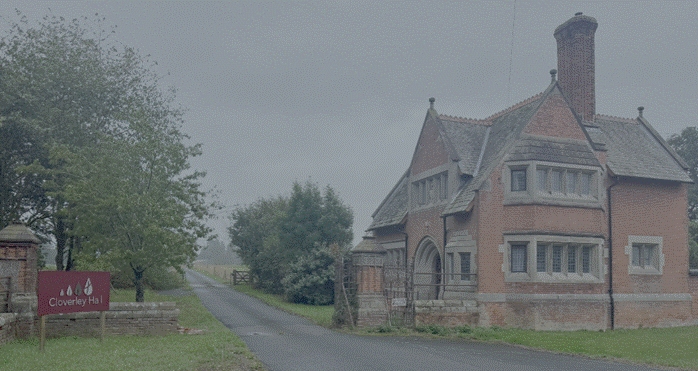
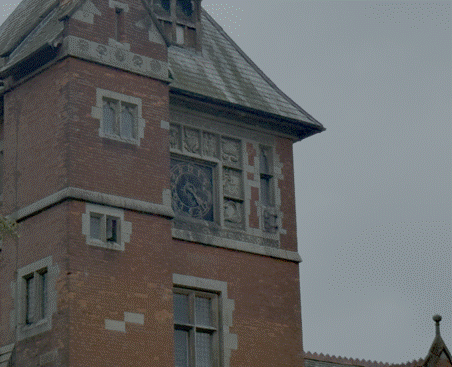
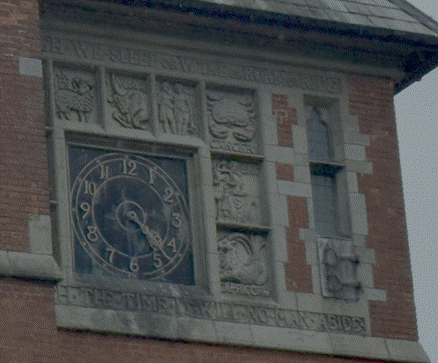
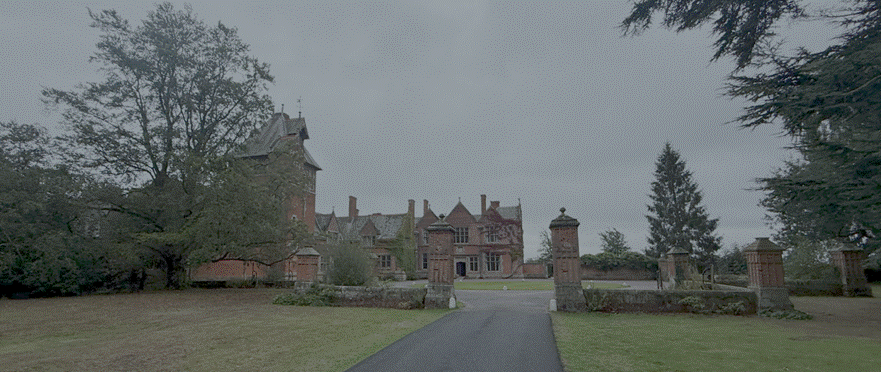
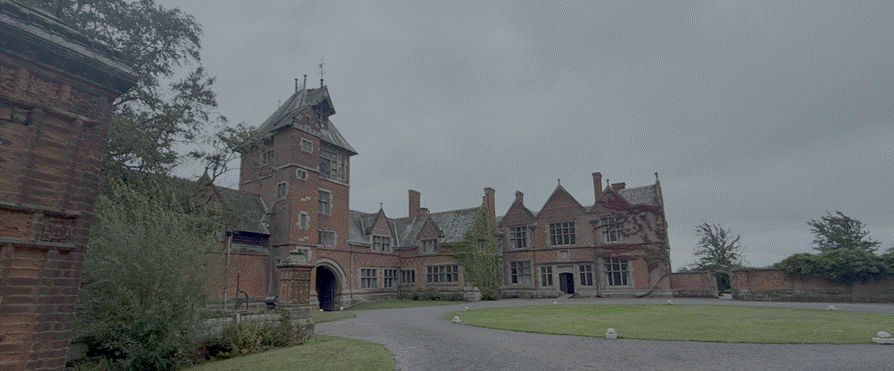
Cloverley Hall is a grade II listed former Victorian
country house which stands to the south-east of the village. It was originally
built between 1864 and 1870 by architect William Eden Nesfield for Liverpool
banker John Pemberton Heywood. In its original form it was unusual in having a
great hall in a Victorian building but the main wing
was demolished and rebuilt in 1926-7. It is constructed in two storeys to an L-shaped
floor plan. After the Second World War it was converted for use as a boys'
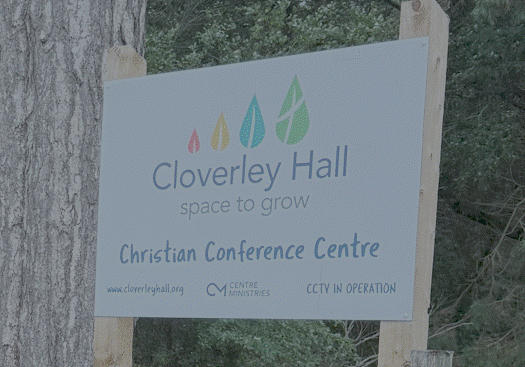
school and since 1968 has been in use as a Christian Conference Centre.
Newstreet Lane
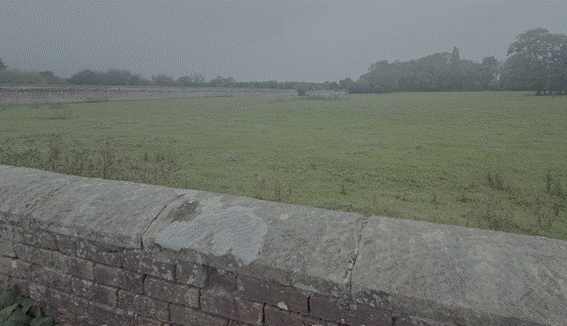
New
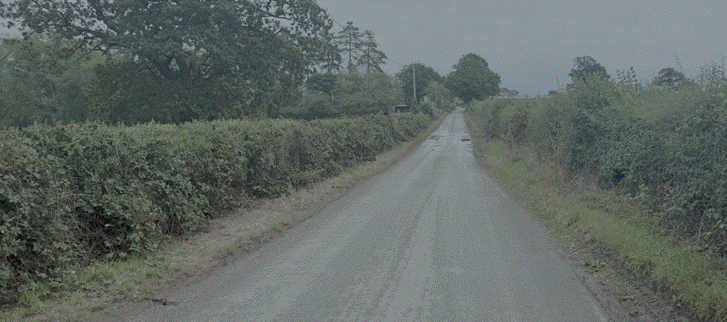
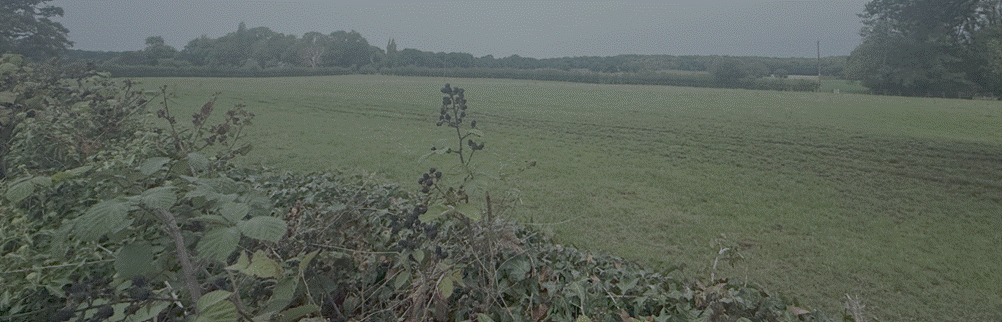
Street Lane, historically recorded as Newstreet Lane,
is a historic rural road and hamlet within the civil parish of Moreton Say,
Shropshire, tracking back centuries as a vital countryside link between the
village of Calverhall and the market town of Market Drayton.
The lane's history of human settlement stretches deep into the Middle Ages. Its
most significant archaeological feature is a medieval moated site in Moat
Plantation, or Newstreet Plantation. This scheduled
ancient monument features a rectangular moat platform typical of the
high-status medieval manor houses of wealthy families (Moated
site immediately north west of Cloverley Farm,
Historic England Scheduled Monument 1019654).
The moated site is adjacent to Cloverley Farm to the west of Cloverley Hall,
beyond the end of New Street Lane.
In
the mid-1500s, Hugh Chester resided at Newstreet
Lane, held extensive surrounding pastures. The
estate passed to William Dod of Newstreet Lane (c
1537–1599). The Dod family was highly prominent in the region and went on to
construct the nearby historic Highfields estate.
New
Street Lane Farmhouse, formerly Unity Farm, is a protected Grade II listed
building, which includes a seventeenth century timber-framed core that was
heavily remodelled with red brick in a Gothic style during the mid eighteenth
century, followed by a Victorian wing addition in the late nineteenth century.
Bibliography
Williams, Gareth (2023), 65 – Cloverley Hall, in
The Country Houses of Shropshire. *
History, Cloverley Hall, Parks
and Gardens.